On the occasion of this milestone, we celebrate with a long, narrative interview a language that, over time, has established itself as one of the most recognizable and, at the same time, unclassifiable on the contemporary scene. A body of work that transcends every disciplinary definition to become a poetic gesture and a vision: a way of looking at reality not to describe it, but to transform it.
At its core lies a conviction as simple as it is radical: nothing is ever only what it appears to be. Even what seems marginal, incomplete, or forgotten can reveal an unexpected possibility of beauty. It is from this tension that Tolomeo’s sculptural chairs are born: wounded, abandoned objects restored to a new life through a process that is at once intimate and visionary. Rather than reinventing reality, Tolomeo moves through it and bends it — returning it each time lighter, more alive, freer. And it is from here that this conversation begins: from thirty years of chairs, certainly, but above all from a stubborn and poetic idea of transformation through art and creative thought.
The key word is transformation. Since 1996, I have always started from an abandoned object, from a seat that consumer society has discarded, in order to give it a new life. Because transformation is part of our existence: it is often painful, sometimes traumatic, but necessary. And above all, it is up to us to try to transform even what in life appears ugly or wounded into something beautiful. This awareness came at a very difficult moment in my life: I had a depressed mother, I had given up my career for my family, and it was precisely that fracture that became a turning point. Since then, everything begins with a found object, almost always reclaimed: a chair that I collect, observe, listen to, and from which I begin to imagine a metamorphosis. In Pinerolo I had an attic full of broken chairs, the kind of family chairs missing a piece of the backrest or with a wobbly leg. They were objects already full of memory, apparently finished. But it was precisely from there that everything began
Yes, because things are not to be endured: they must be changed, through action and not just thought. Because a chair is never just a chair; and, ultimately, nothing in life is ever simply what it seems. One must understand that reality is often cruel, and it is up to us to try to bend it, to make it better.
It’s not about denying reality, but transforming it into something that lightens it, that frees it from the heaviness and boredom of everyday life. I make people dream with their eyes open, because life must be lived, not just thought.
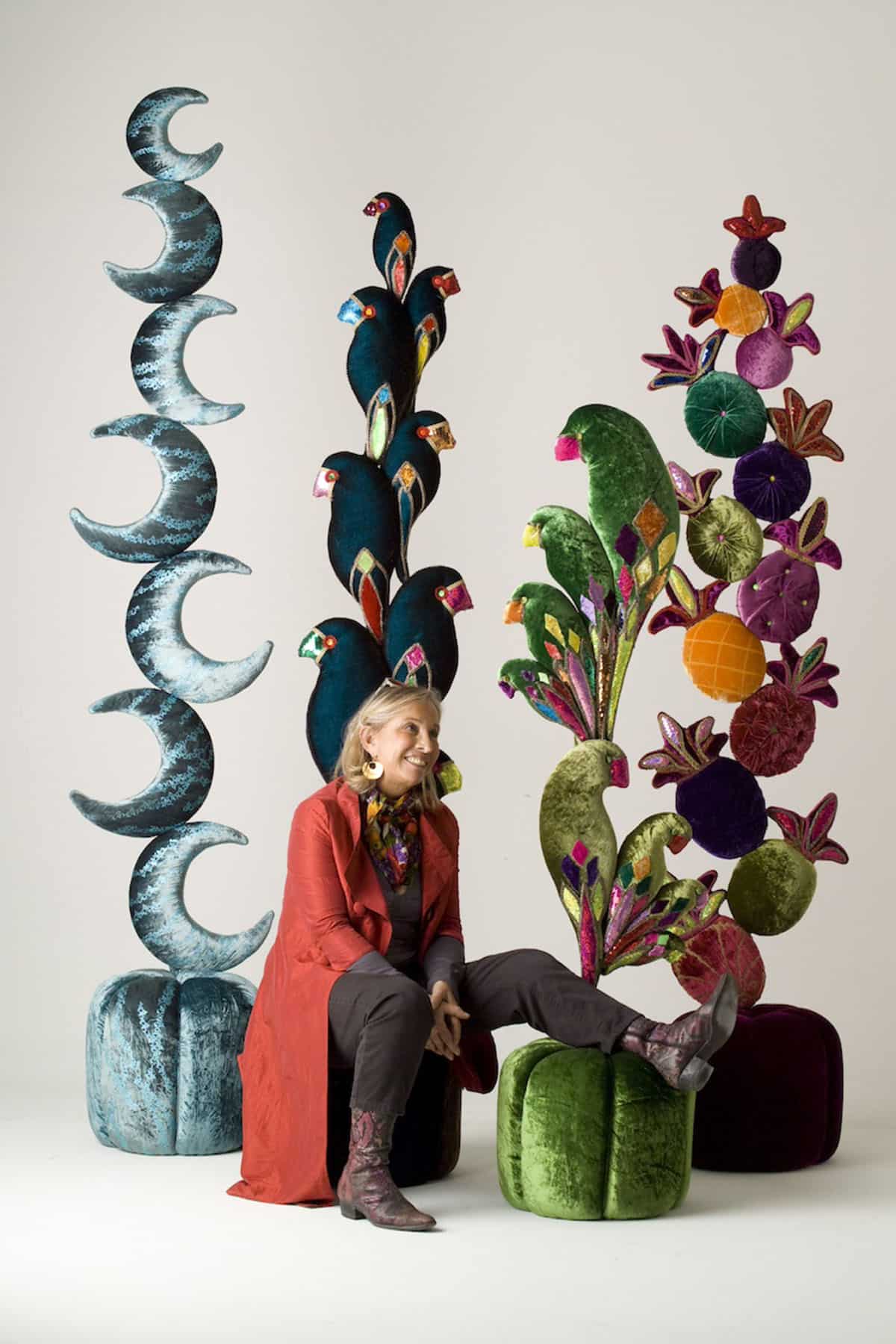
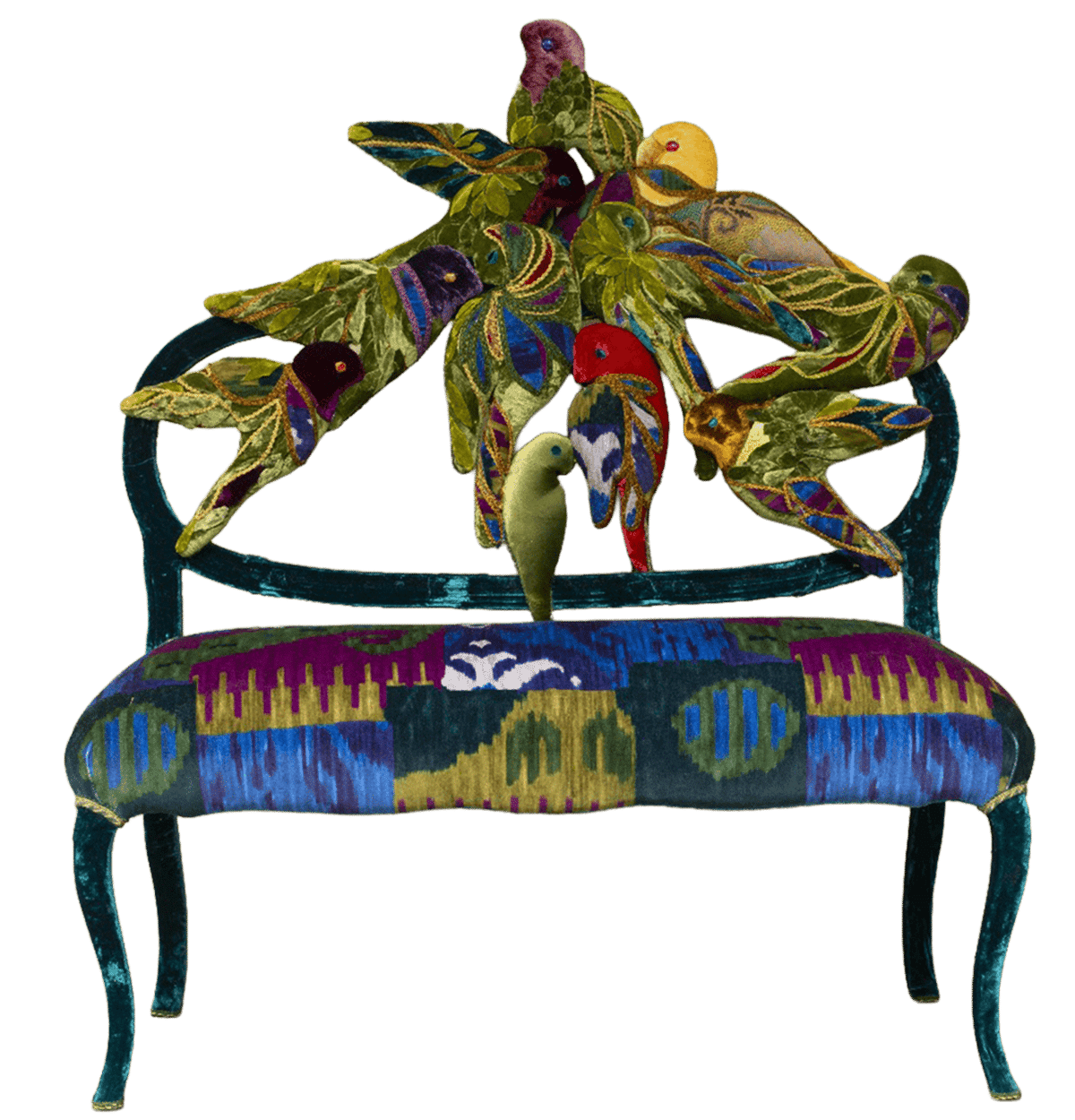
The first form was a dolphin, perhaps also because I’m a Pisces. I immediately grasp the overall structure; then the details can change during the work. At that point, color comes into play. I was born a painter and I still feel like one: fabric, for me, is a palette. Perhaps that’s also why I’ve never had a real relationship with black. When I sense the whole, that’s when I truly begin to work. Over time, other forms arrived: parrots — and there was also a major article about me — and shortly after, turtles, although I think the turtle was already inside me: it is one of my totem animals. What might surprise you is that the drawings, which fill my studio, almost always come afterward, rarely before. It’s as if they return to painting what is born from my sculptural work.
I feel them. It’s hard to explain otherwise. I feel them — it’s instinct. I’ve always worked this way in painting as well. I painted alongside great painters who welcomed me into their studios: there are those who work impulsively and those who construct everything starting from a perfect, pre-prepared drawing. I belong to the former. The work finds its own proportions. It creates itself.
I love fruit salad, but not in chairs. There’s something in me that doesn’t sound right when I put too many different things together. Sometimes I slip a moon among the turtles, yes. But in general, I feel the need for each work to maintain its own internal coherence. It’s not that every chair has to be dedicated to something specific: it’s more a question of harmony. I feel when something works and when it becomes a miscellany, and then it no longer convinces me.
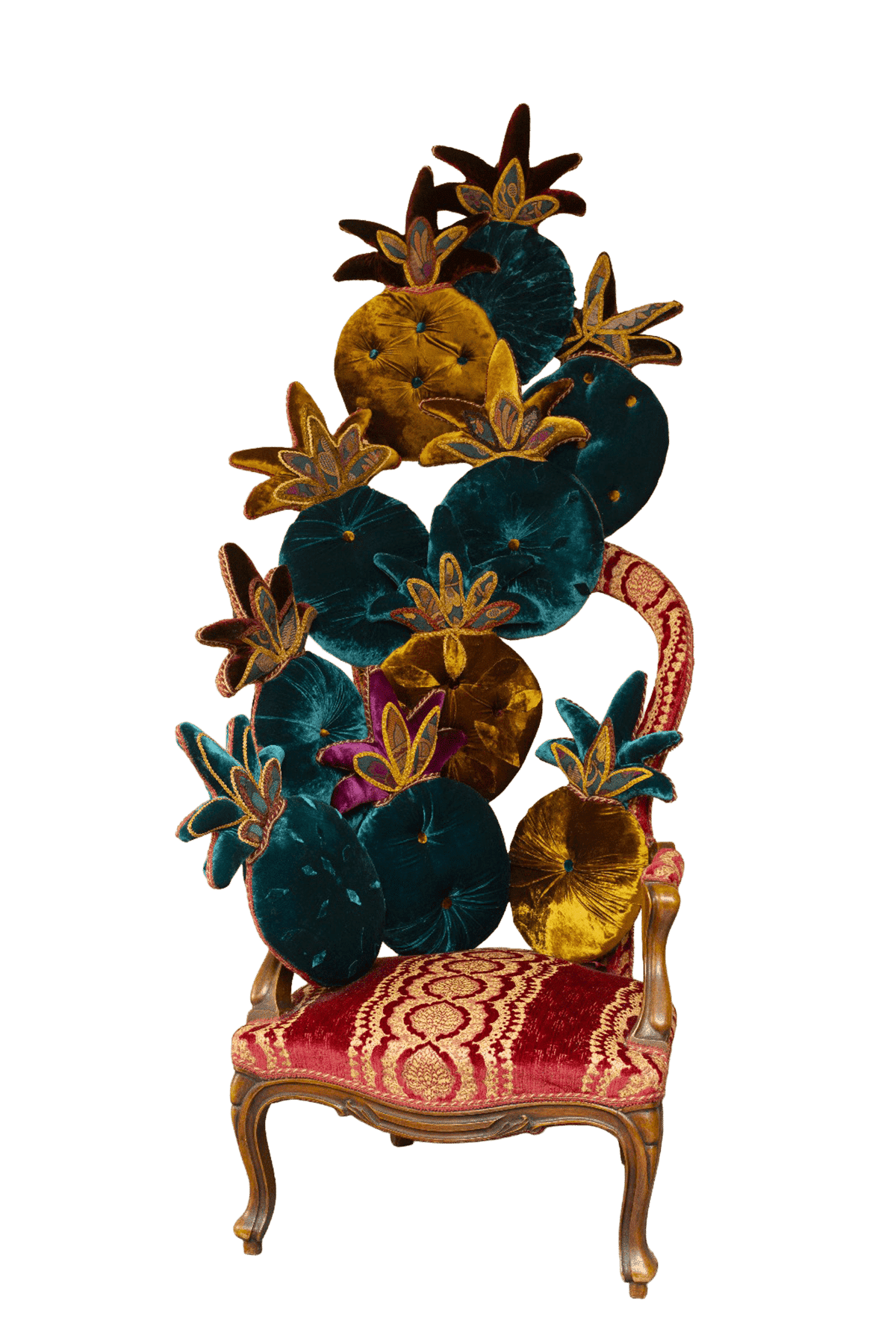
Not at all. I had started convinced it was something temporary, almost a six-month phenomenon destined to fade quickly. Instead, it kept growing, transforming, asking something new of me each time. At the beginning I had to make do. Over time, however, I learned to search better, not to stop at the retailer, to go directly to the manufacturer. For certain fabrics, for example, I go to Bevilacqua in Venice and drive them crazy, because I ask them to pull out an endless number of samples.
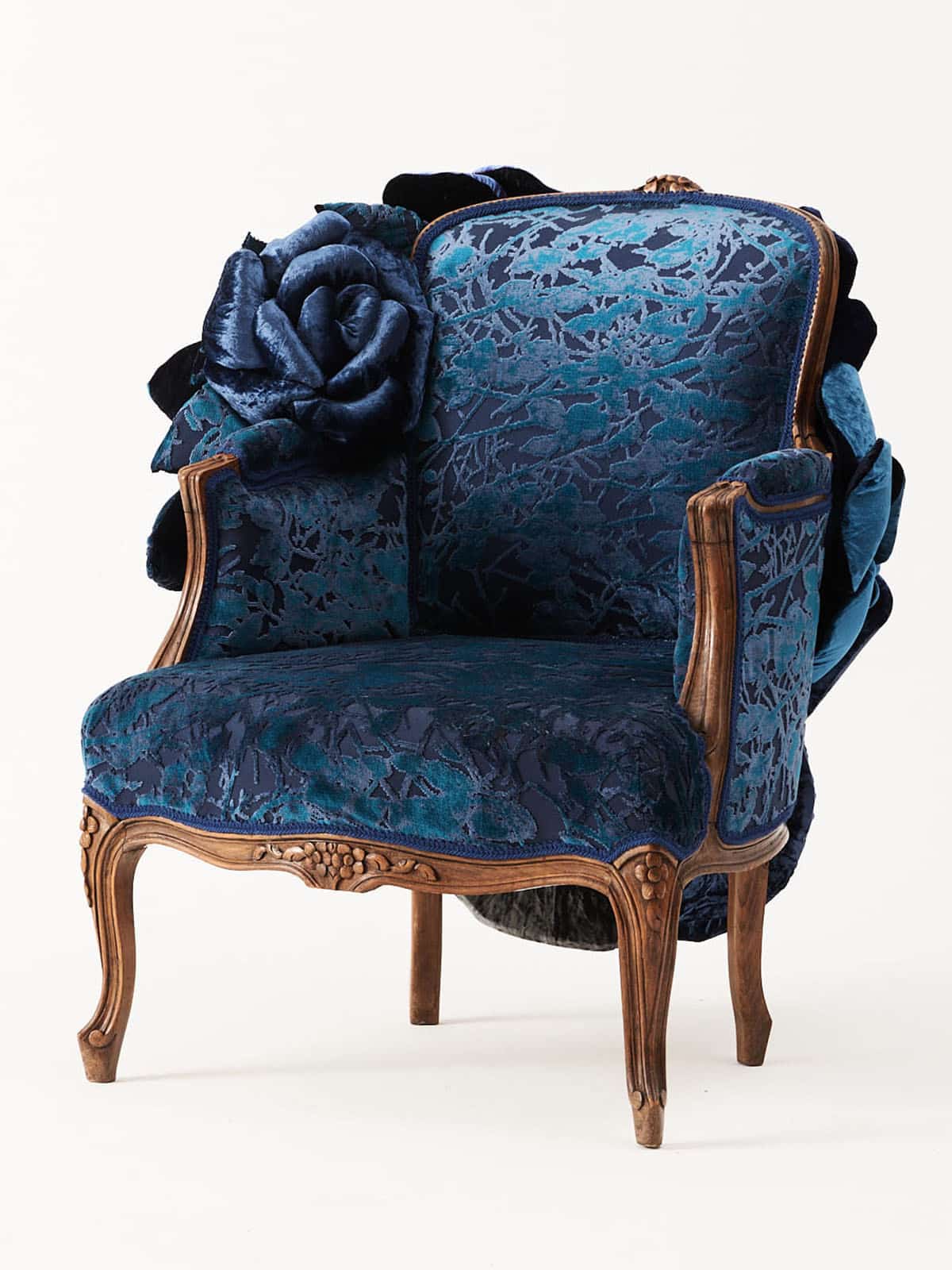
It’s true. Roses are very successful, but I don’t love them that much. Because, in the end, a rose remains a rose: the transformation there is minimal. It is mainly an aesthetic matter — unless something else happens. For example, the pouf entirely covered in roses: that I love very much, because there the transformation is real. A round shape becomes even rounder, almost exaggerated, because of all those round roses covering it. Before the roses, however, there was a gardenia, commissioned by Franco Maria Ricci.
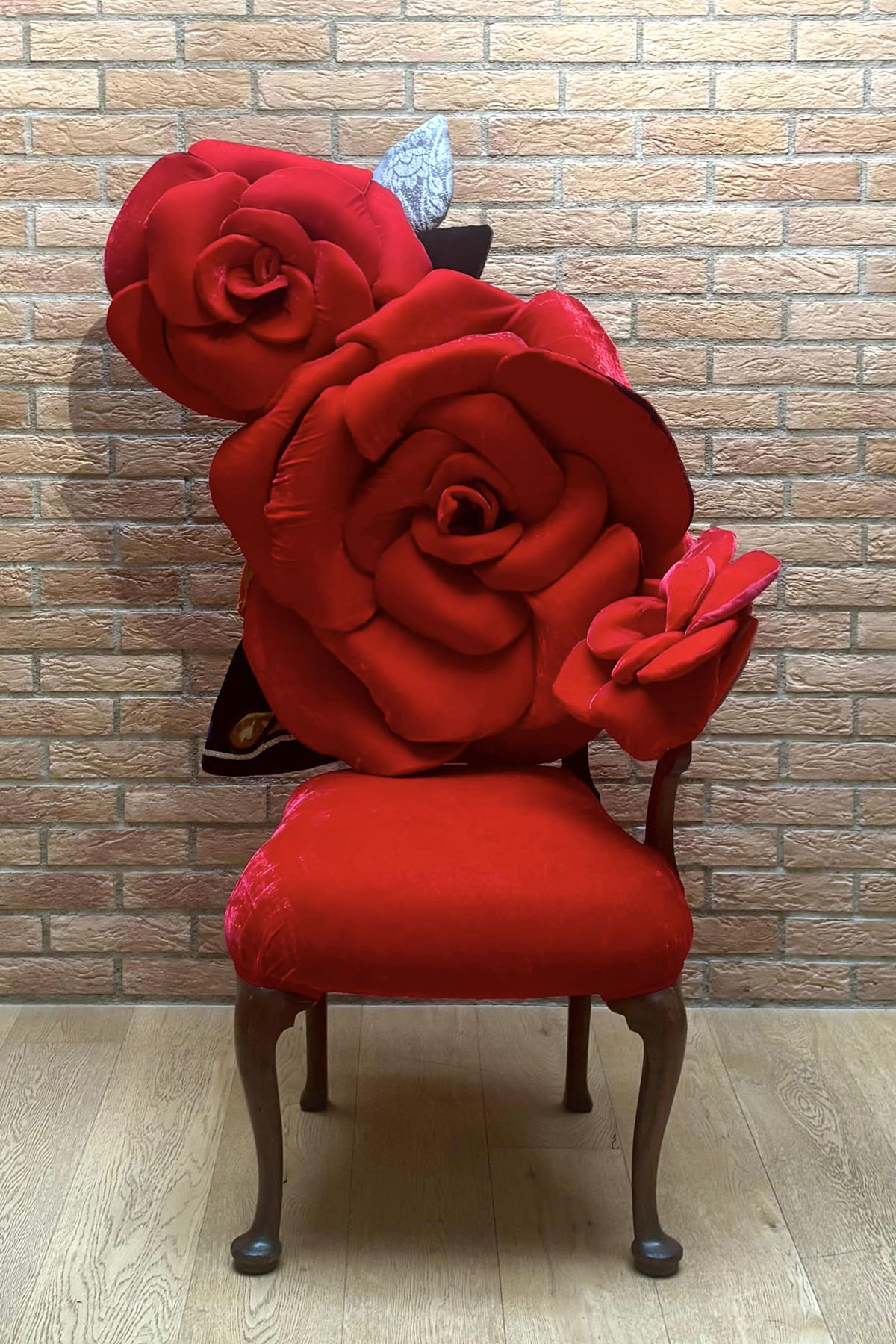
Of course. I can assemble a chair, look at it, and immediately realize it doesn’t work. Then I take everything apart. But even the form is never entirely definitive: there are days when something convinces me, and the next day it doesn’t anymore. I look at it again and think, “No, this doesn’t work.” I often return to my works, making many changes along the way. I see the general structure right away — I usually have no doubts about that. But the detail must be thought through, reconsidered, corrected.
Over the years I have received a lot of love from the public. What makes me smile is those who reject these works, because often in that rejection there is a difficulty in embracing the new, or in accepting a different function for the object. It’s a form of mental rigidity: those who cannot transform with time end up, in a way, remaining old. I would never say “I wouldn’t want it even as a gift,” because it’s a kind of closure that would make me ashamed. I can say “I don’t like it” or “it doesn’t correspond to my idea of art,” but I stop there. Also because, over time, one’s gaze changes — and what we reject today might speak to us differently tomorrow.
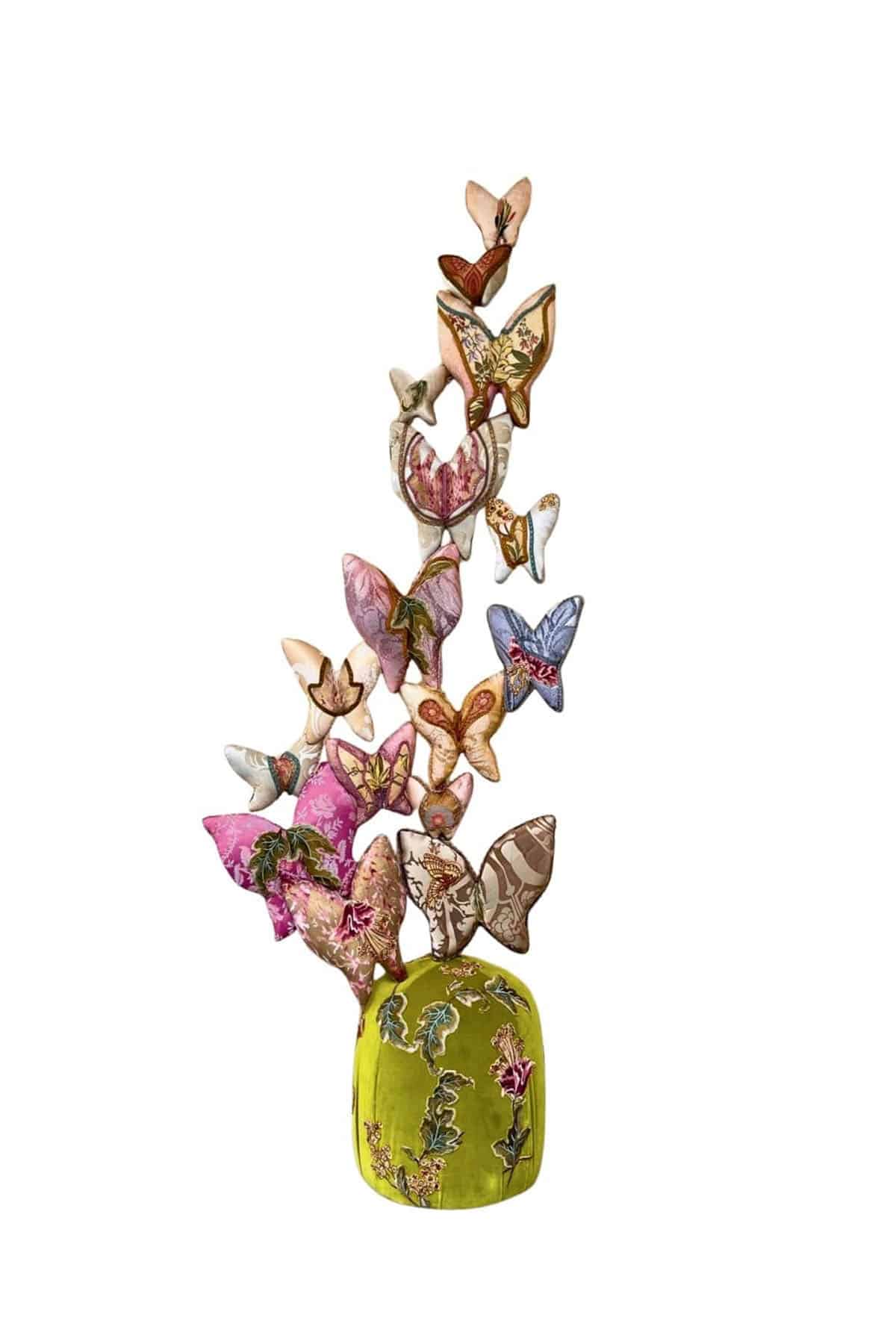
Yes, of course. They must be used. If I wanted to create an object as an end in itself, I would make sculpture: I have worked with marble, I make ceramics. Here, instead, I want to create something one can live with, something that can make those who encounter it feel happy. Not just contemplation, but experience. If you think about it, objects were born beautiful, even before the word “design” existed. Wooden utensils had beautiful shapes, earthenware plates were beautiful, the houses of the Venetian countryside — with their external staircases — are little jewels. Human beings have a natural aspiration toward beauty. It is contemporaneity that has imposed usefulness over beauty. And even design, at times, in wanting to be design at all costs, ends up forgetting its function.
The interview with Carla Tolomeo marks a new chapter in L’ARTE IN PRIMA PERSONA, a project promoted by CRAMUM together with Schiavi SpA, under the artistic direction of Sabino Maria Frassà.