Freedom, play, subversion: these are the key words running through the life and artistic research of Paola Pivi, one of the most internationally acclaimed Italian artists. Born in Milan in 1971, yet a citizen of the world by vocation and civic spirit, Pivi has built a nomadic path without a fixed destination, where social commitment and the playful dimension intertwine until they become a single gesture: opening spaces of possibility without limits or labels.
On the occasion of May 17 – the International Day Against Homophobia, Biphobia and Transphobia – this conversation invites us to return to the deepest core of rights: not as sectorial claims, but as universal conditions of being. Rights that do not concern “someone,” but everyone; that are not defended one at a time, but together; that do not ask for identity-based allegiance, but for the recognition of the freedom to exist, to love, to belong.
It is from this perspective that Paola Pivi’s work reveals itself as profoundly political without ever becoming ideological: politics does not enter as an explicit theme, but as a method. Art itself becomes a civic space, capable of shifting perspectives without imposing a thesis. Wonder — generated by absurdity and play — becomes at once a critical and subversive gesture: it cracks what seems natural, makes invisible rules visible, and suggests that reality itself can change.
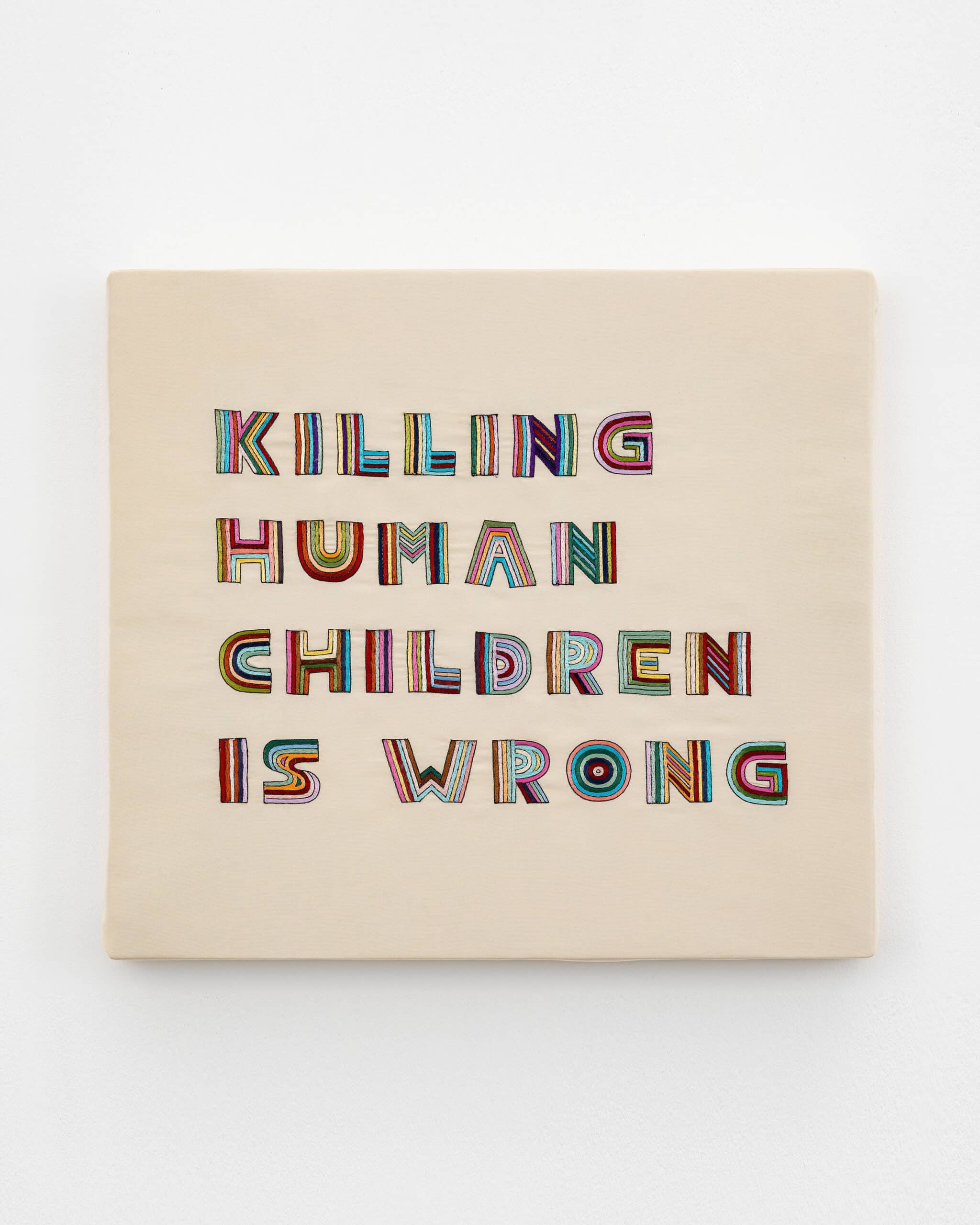
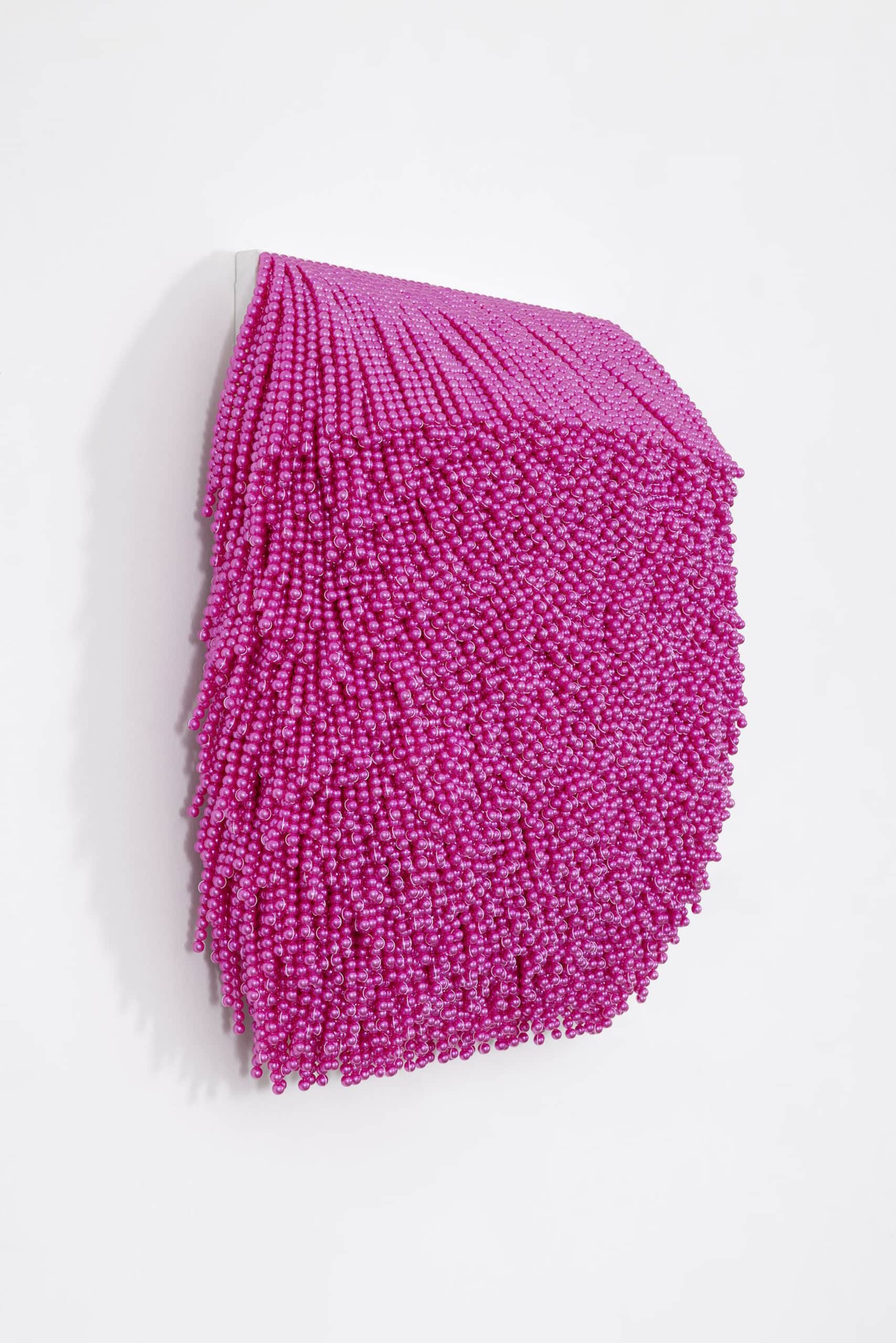
Her visual universe — from the iconic anthropomorphic bears to pearl paintings, from comics to suspended airplanes — seems to emerge from a fantastical dimension that nonetheless makes reality more legible precisely by displacing it: everyday life transforms into a dystopian reality that feels surprisingly close, and within that subtle unease lies the strength of her work.
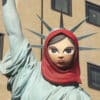
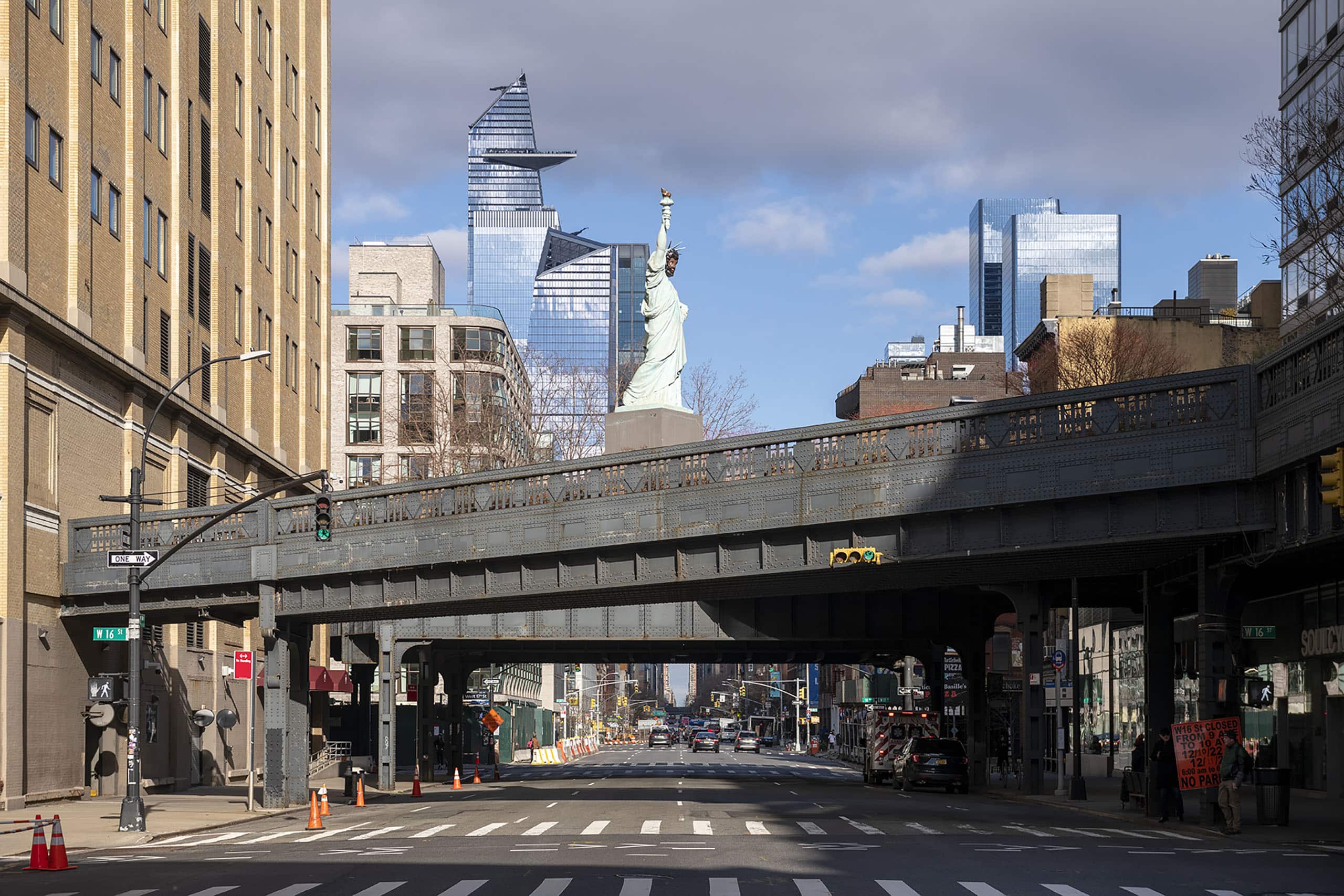
This is not play as escapism, but play as subversion: a device that disarms hierarchies, destabilizes rigid categories, and fractures what appears “natural.” Emblematic in this sense is You know who I am: the Statue of Liberty, a universal icon of emancipation, wears interchangeable masks inspired by the language of emojis and connected to real people. Identity is never fixed once and for all: it becomes mobile, plural, not immediately readable. The mask does not conceal, but protects; it does not remove truth, but claims the right not to be reduced to a single definition.
This freedom, in Pivi’s narrative, never remains abstract: it confronts places, borders, documents, and the possibility of staying together. For this reason, her voice — more celebrated abroad than in Italy, where she is nonetheless now considered an icon of contemporary art and increasingly present in private collections — It resonates with particular strength when discussing rights, because it shows how art can be profoundly democratic not when it simplifies, but when it includes without normalizing, when it opens a space in which each person is called to rethink what freedom, identity, and belonging truly mean.
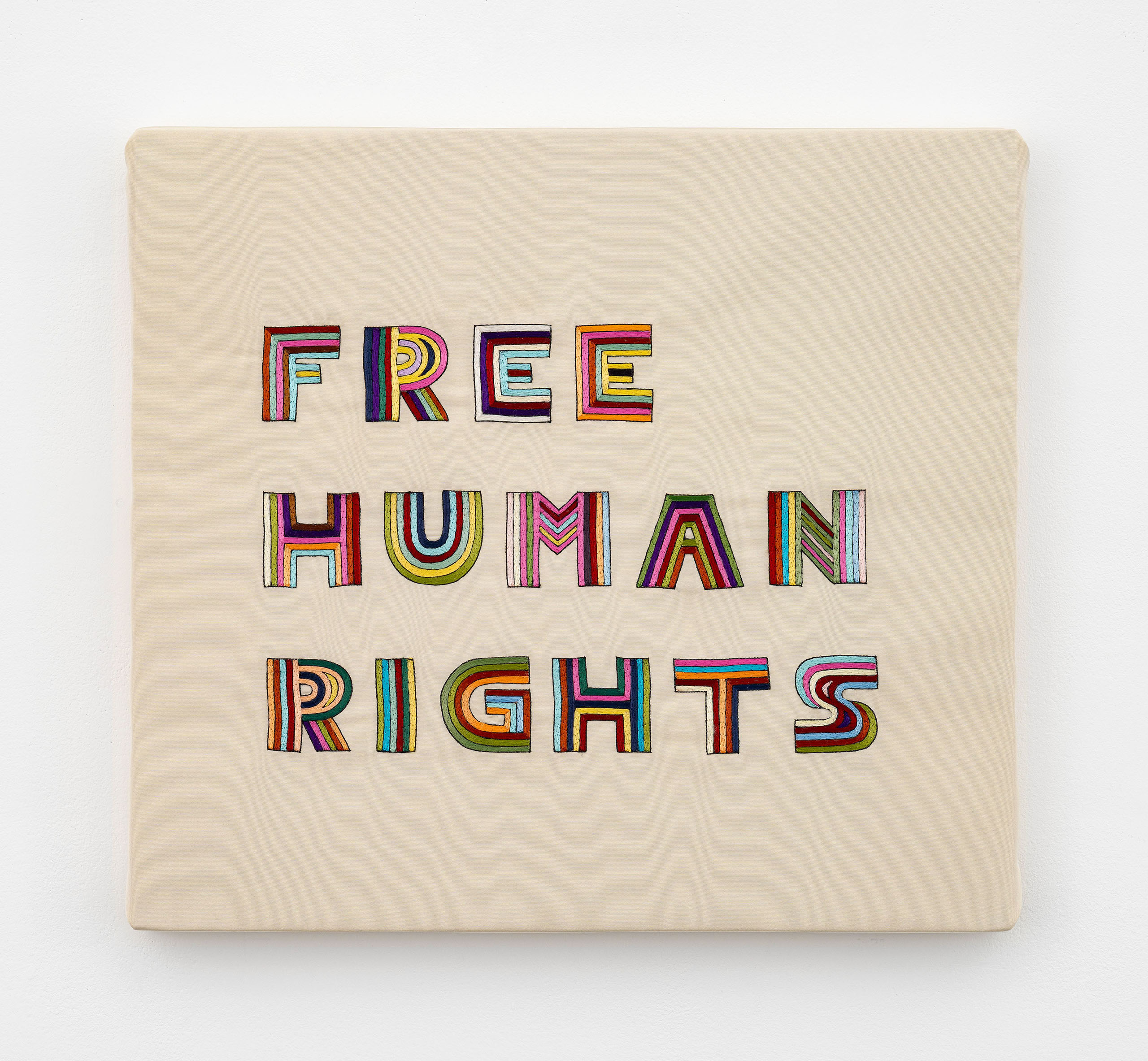
Paola Pivi granted us a long, authentic, and passionate interview, developed over several sessions between November 2024 and today. A nomadic dialogue, born and shaped between Alaska, Hawaii, and solo exhibitions around the world — including Come Check It Out. Lies lies lies at the PHI Foundation and A girl loved pearls so much, she left engineering, strung them off the wall, and made art at Massimo De Carlo in London — and driven by the same urgency that makes this conversation even more vivid and necessary today: to remind us that freedom and identity are not abstractions, but forms of life, relationships, and concrete possibilities.
Much has already been written and said about her, yet her deeply personal and socially engaged world deserves to be told “in the first person,” through her own voice — capable of holding together play and responsibility, disenchantment and vision.
Let us therefore leave space for her words, powerful and evocative, just like her works.
Paola Pivi: I start from a vision, from the need to tell it, and I create a space of freedom in dialogue with others, with the world, and with History. Everything I create emerges from an unconscious process: there is no explicit intention behind my works, but rather a spontaneous flow of ideas and visions. That is why I try to reduce to a minimum the steps between these visions and the final works, as if I wanted to keep the ideas suspended above the ground, to truly realize them, yet without fully bringing them into the concrete world.
P.P.: Since 2006, my husband, Karma Culture Brothers, has been part of my life. I met him in Alaska the second time I returned there. It was love at first sight: with him, I do not simply share existence — I live it fully, every single day. Since he entered my life — as a composer, poet, and musician — the title has taken on a new dimension, almost becoming a work within the work itself. My work sometimes seems to become a pedestal for the title, an intertwining of sounds that transform into a small poem, almost a haiku, capable of opening doors and immersing the viewer in a magical atmosphere, without imposing a rigid interpretative key.
Art is the fabric of our life together, so deeply that I cannot even remember the first time he suggested a title for one of my works. He still does it today, always, and I fully recognize its value. And yet, precisely because the title plays such an essential and specific role, I still sometimes choose Untitled. It is not a laconic choice, but an essential one: some works simply exist for what they are, without needing anything else; others, instead, seem to emancipate themselves precisely through the title that accompanies them.
P. P.: I only realized I was an artist in 1994, when I opened the classroom door where Alberto Garutti was teaching at Accademia di Belle Arti di Brera: opening that door felt like coming home. My art was never a conscious choice, even though I was born an artist, but rather a path I discovered along the way. I come from a family of engineers, but also of artists who repressed their art: one of my grandfathers painted, the other organized happenings, yet life led them to become an architect and a doctor. And I, too, had a natural aptitude for engineering, but it made me unhappy. When I discovered art, I understood that it was my true path. I left engineering and enrolled at the Brera Academy, even though at first they had not accepted me. In the end, though, it truly felt like coming home.
P. P.: I have no doubt: it was the art of Andrea Pazienza. When I was studying at the Politecnico di Milano and felt the need to escape, I would take refuge in comics, which were art — imaginative worlds and languages. At the time, my eyesight allowed me to perceive them almost in 3D, to enter them and grasp every detail, which I would then copy and draw. And in those moments, I was much happier.
So, after passing some exams with excellent results (Physics II with a 28 and Quantum Mechanics with highest honors), I decided to leave engineering. My family stopped speaking to me for six months, and in the meantime I supported myself by teaching aerobics, while continuing to study, because I have never believed I could live without studying, that is, without learning new things.
That is how I arrived at Accademia di Belle Arti di Brera: at first they rejected me, then they took me back. I have been exhibiting since 1995, and then there was Massimo De Carlo, who inaugurated his new gallery with me, an unknown student. But those were different years, a different Italy, a different art world, in which connoisseurs were almost like a sect, just a few people moving through their own spaces and necessary silences.
The audience was different too: it allowed experimentation, daring, even the freedom to make mistakes and change one’s mind.
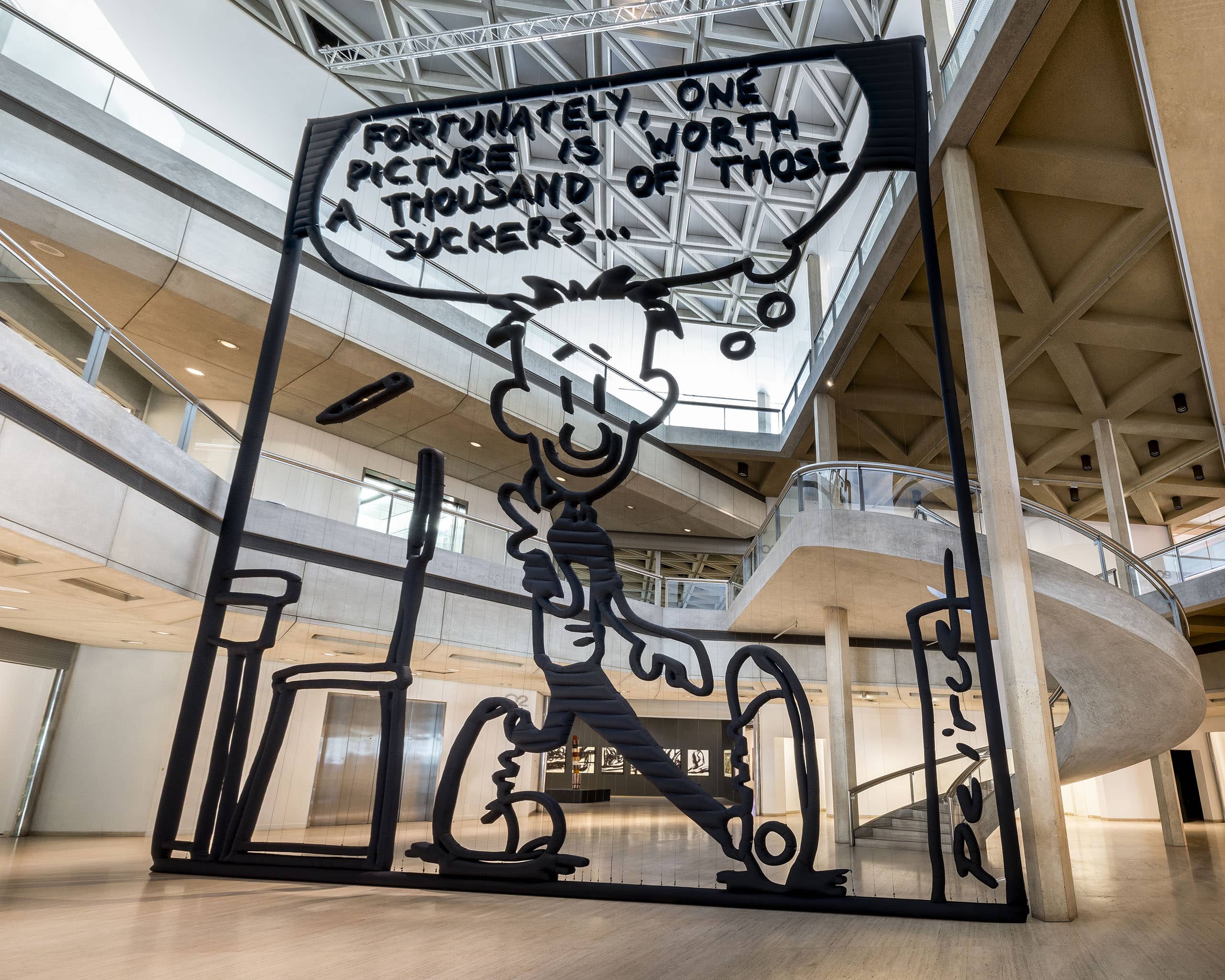
P. P.: Absolutely not. As I was saying, I don’t believe in preparatory works. An artist must have a vision and then push that great boulder that brings it into reality — that is how I work. The creative process must preserve the purity of the original intuition, without mediations that would dilute its intensity.
P. P.: Creating is like managing to push an enormous boulder. It is a direct confrontation with the present, with a constantly changing society. Every work carries a date, a moment in History. I have more projects than I will ever be able to complete, but the creative process always remains a struggle: a precarious balance between vision and reality. One must learn to wait and keep hammering away; not all the projects I wanted to make were brought to completion, but some, over time, have also evolved and become enriched with new elements and dialogues with new circumstances and historical opportunities, like my work Live again, made of lemon trees and bronze, which began in 1999 and was completed and presented for the first time this year, in 2026, at the Perrotin in Paris.
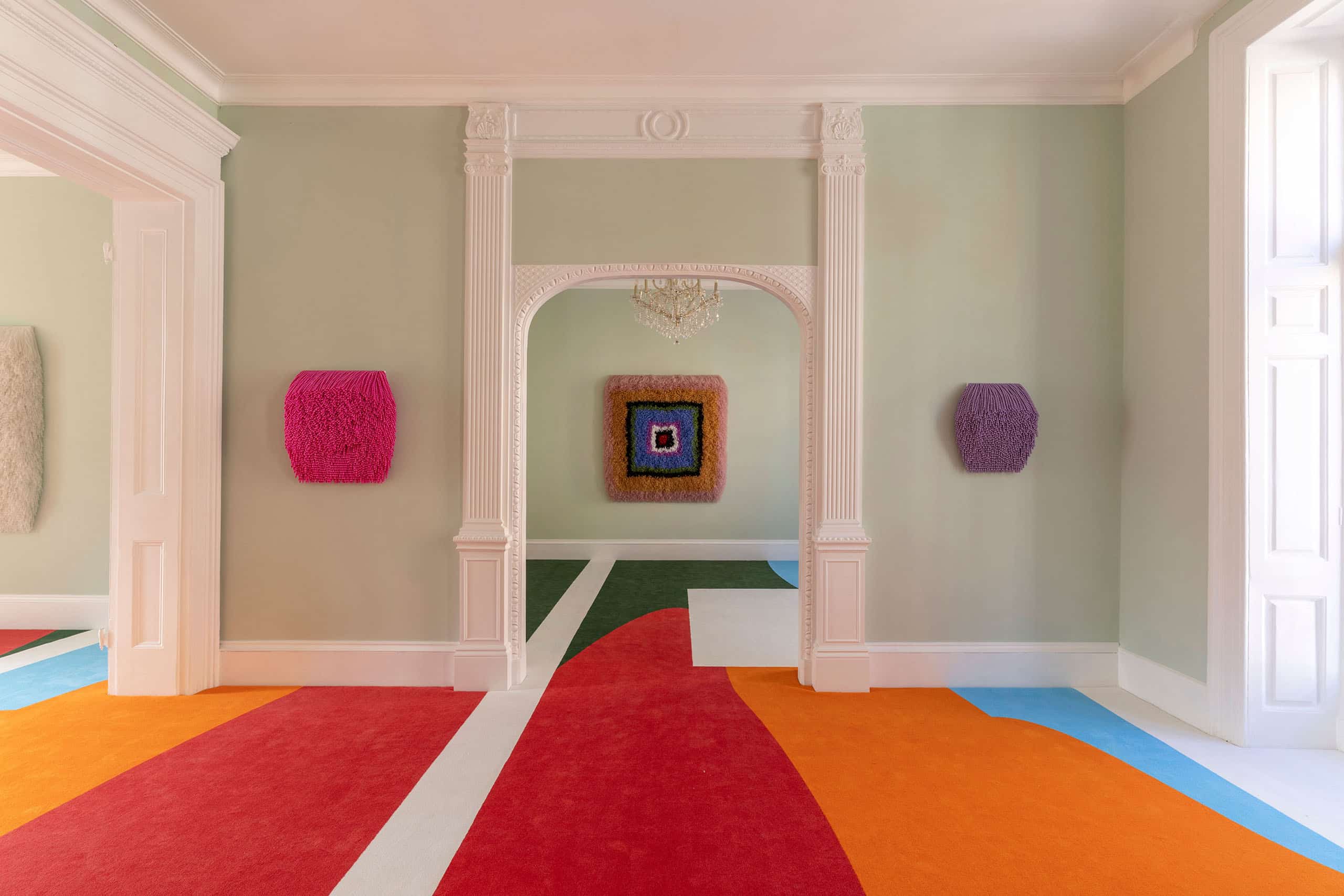
P. P.: Unfortunately, I would say I am better known abroad than in Italy, where many of the things I have done remain less recognized. Being a woman and an artist is never simple. That said, if there is one body of work most closely linked to my engineering background, it is the one with pearls, which I have been making since 1998.
At the time, my husband was not yet in my life, and those works were simply titled Untitled (pearls), whereas today they carry the kind of titles we were talking about, such as Call me anything you want from 2013.
In these works, the pearls are arranged in tight rows, but then they take shape under the action of gravity. This is the practice that brings me closest to my engineering years — not so much in a tangible sense, but as an expression of physics. For me, pearls are also an aspirational symbol of luxury, a desire for possession. And luxury, anywhere in the world, is nothing other than stored, accumulated, and set-aside energy.
P. P.: I don’t like staying still. Every place I live in becomes a new starting point. I don’t have roots, or rather, I have them scattered everywhere. My family background is an interweaving of cities — Bari, Novi di Modena, Pescara, although for years now they have lived in the province of Varese.
Since 1998 I have worked with Massimo De Carlo, an encounter that meant a great deal to me. And yet, Milan continues to repel me like a magnet. I was born there, amid my family’s constant movements, and it is a place that attracts and repels me at the same time: I always have to go back, but after a week I feel the need to leave.
By choice, I have put down roots in Alicudi and Verrand, fascinated by the beauty and power of nature. But if I think of home, it is Alaska. That is where I even chose to buy a house, and it is there that I met my husband, a Tibetan exile. Then I also lived for two years on Big Island.
Alaska was an extraordinary discovery, a place of absolute freedom. In the first years I spent there with my husband, I breathed an incredible sense of possibility. But it is also the land of bears, which still frighten me and, at the same time, attract me. Just like Milan.
P.P.: It was a shocking experience. I had received an invitation for a bohemian trip to Antarctica with friends of friends who were artists, but at the last moment I was disinvited. I found myself with six free weeks, and, after reading an article about Roberto Ghidoni, I decided to pretend to be a journalist to follow the Iditarod, the most epic sled dog race in Alaska: 1,049 miles of pure adventure. I rented a Super Cab, met Roberto Ghidoni — a true Italian moose, his nickname, because he is one of the few able to walk the entire route — and lived six unique, almost magical weeks. It was a vacation from myself: I immersed myself in a completely different world, pretending to be a journalist and living every moment as an explorer. The following year I returned to Alaska. Upon arrival, a friend of mine sent someone to pick me up, the very man who would become my husband.
P.P.: For four years I lived in India to legally fight and win against the power of the theocracy of the Dalai Lama, and in this very intense experience my husband and I were adopted by our son, a five-year-old stateless child. We fought for our son, adopting him and bringing him to United States and then to Italy, because for me family means being united anywhere in the world. Now my son is in his first year of university. America, a country with a complex history of freedom, allowed him to obtain documents and therefore rights. Italy, since my son was stateless, did not allow it.
P.P.: “You know who I am”, presented in 2022, was born from a completely pure idea: to create a connection between freedom and identity, and to tell real stories. The mask worn by the statue represents a real person, with a first and last name, whose experience of freedom is linked to the United States and whose story is explained near the work. The first portrayed figure and the inspiration for the piece was my son, but I did not want the work to present experiences linked exclusively to freedom as a positive possibility in the U.S. American reality, even before recent atrocious events, has always been highly diverse, fragile, and dramatic. The other masks represent stories of deprivation and also abuse. I made the work in bronze during the Covid period, thanks to the collaboration with Matteo Visconti di Modrone, who in those years had decided to teach the ancient art of bronze casting to artists who had never practiced it before. During lockdown, my family and I crossed a deserted Italy every two weeks from Verrand to Milan to continue working with the foundry in a 19th-century atmosphere, carrying forward a project that had deep meaning for me.
The work is a large bronze replica of the Statue of Liberty, placed for a year on the High Line in New York. Over time, it has worn different stylized, colorful masks inspired by emojis, each depicting a real individual with a real story connected to the United States of America. Its position was highly symbolic: from that point, visitors could see the real Statue of Liberty in the background, creating a visual and conceptual dialogue between the original and my reinterpretation. The sculpture was made at the Fonderia Artistica Battaglia in Milan, from a historic plaster cast of the original bronze statue created by Bartholdi himself, now preserved at the Musée d’Orsay in Paris. This direct link with the original work makes my piece not only an homage, but also a new level of interpretation of the concept of freedom, transforming it into something more inclusive and personal.
P.P.: My work is intrinsically political: I perceive it on an epidermal level. I have an extremely in-depth approach to news, also because my husband and I carried out and won a historic lawsuit against the Tibetan Children’s Village institution, linked to the theocratic power of the Dalai Lama. This experience gave me a broader understanding of how power and media narratives work. As early as the end of 2023, I knew that the Democrats would lose in 2024. Apart from today’s shocking news, even Trump’s arrival was not a shock to me, but the inevitable consequence of a profound shift in society. The manipulation of news has deeply marked me, and it is certainly not a recent phenomenon in the United States: it also happened under Biden. With Trump’s arrival, it became blatant, it took on a recognizable face, without the hypocrisy that for years also characterized the American Democrats. And so, as the situation became more and more dramatic every day, as soon as I was able to, I left my country.
P.P.: Art is profoundly democratic: you and I can encounter it with very little money, sometimes even for free. All human beings are thirsty for art. And while it is not at all necessary to own it in order to experience it, it is equally true that ownership — even of a small work, even of your child’s drawing — creates a continuous relationship: a dialogue that is renewed every day, an intimacy that nourishes both the person who lives with it and, in some way, the work itself. That is why I believe owning a work is important. And I am happy that the number of collectors in the world is growing: it is a form of interpenetration, a bond that goes beyond simple contemplation.
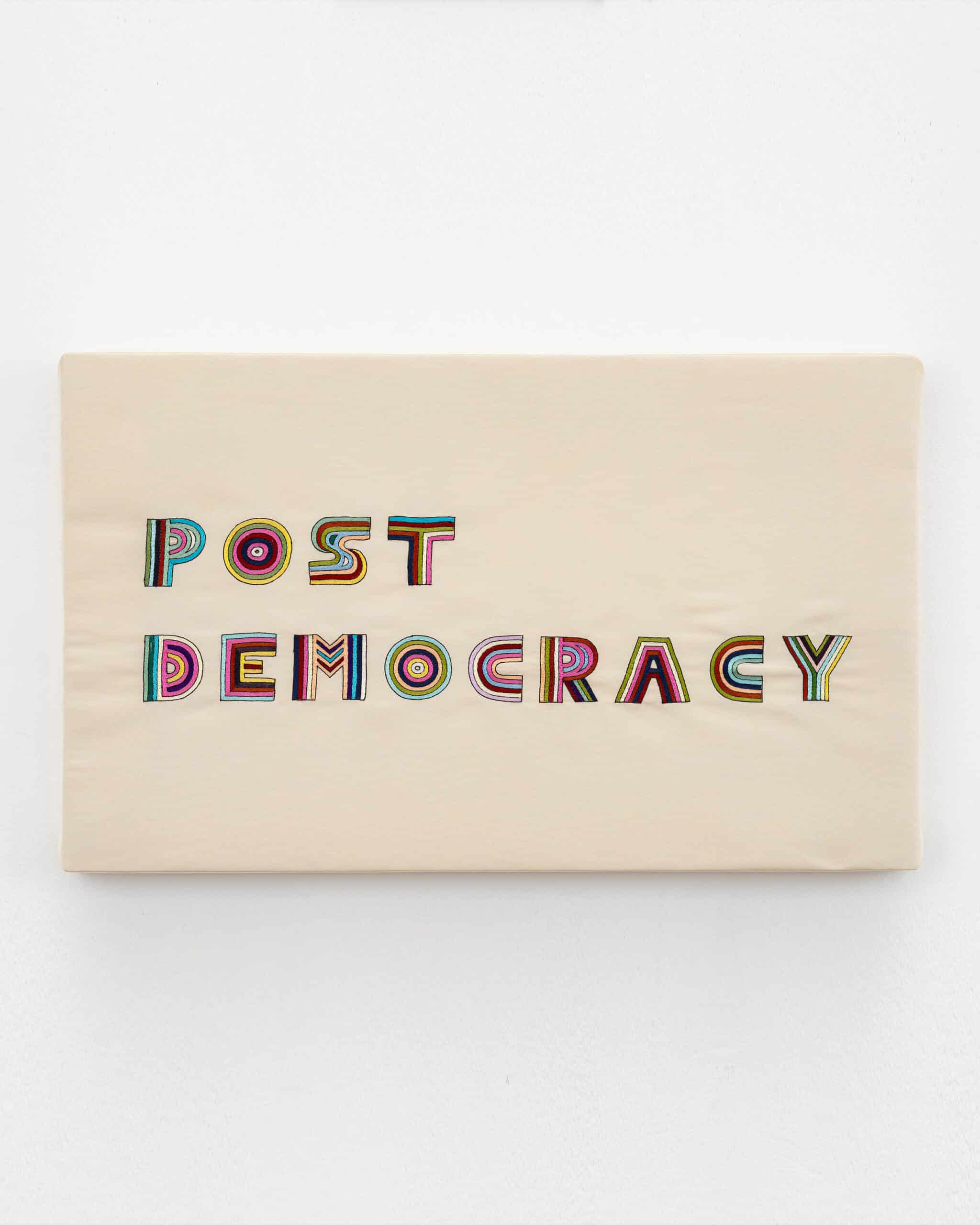
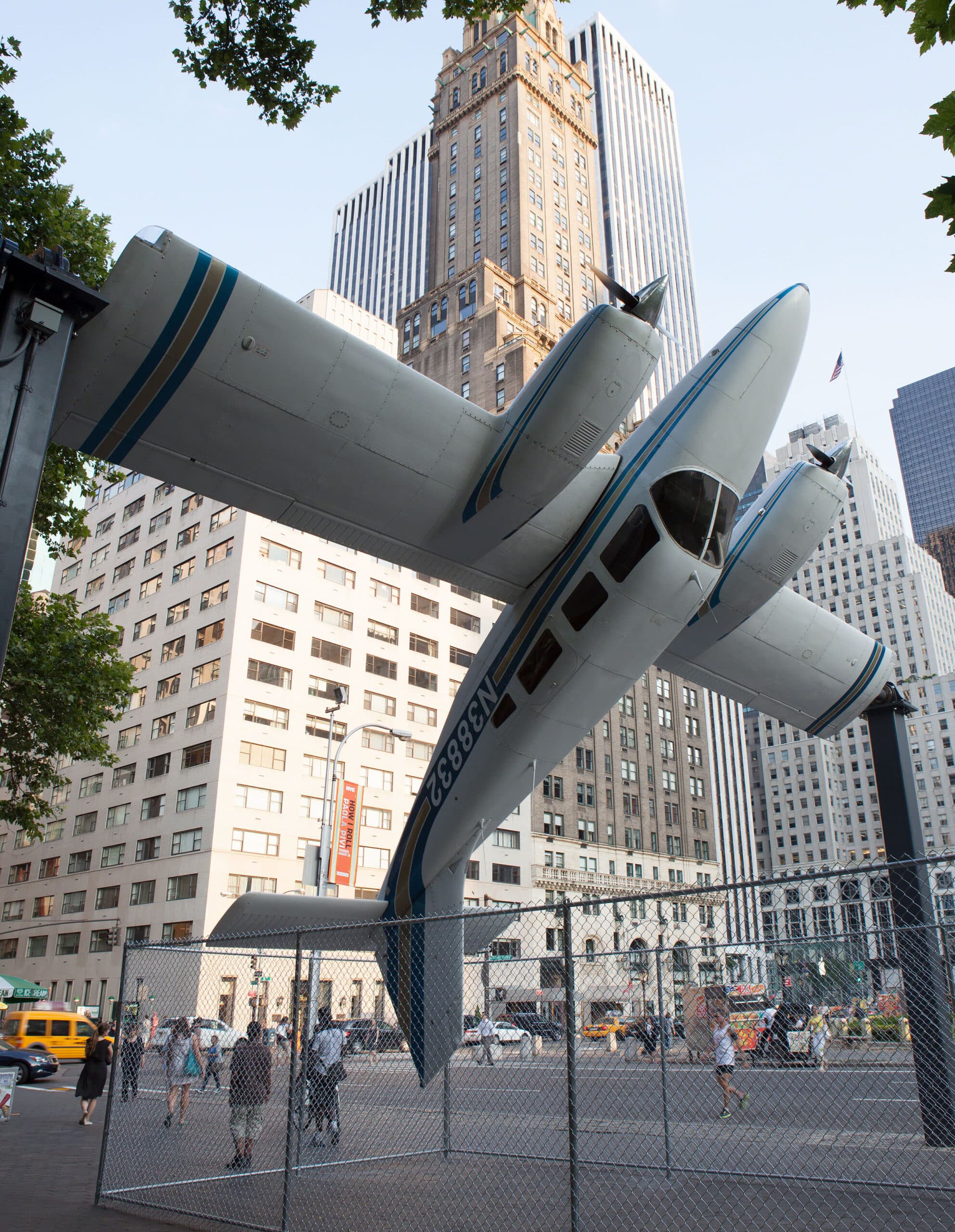
P.P. I love all my works, even those that have remained only visions, those that never became real and perhaps never will, because they have lost their moment, that dialogue with history that made them possible. But it is true, at home I have only one photograph of one of my works. And perhaps it will surprise you to know that it is not the “Statue of Liberty” with my son’s mask, but a work I am particularly proud of, How I Roll, the installation produced by the Public Art Fund in New York, activated in Central Park in 2012: it was my first institutional show in the U.S. Grand, an airplane among small and large ones, a Piper Seneca, rotating forward, suspended from the tips of its wings, a large kinetic work, a game, just as you said at the beginning, and as many recognize as the essence of my work.
P.P.: At the beginning, when I was young and then as an emerging artist in Italy in the 1990s — a period in which artists were almost isolated from the world — I had a more extreme vision of myself, even though I have always loved having fun. I only became aware of the so-called playful aspect when others pointed it out to me, because my approach is instinctive, driven by the unconscious. I recognize it now, but it is not something rational, and I never let myself be influenced by any kind of intention.
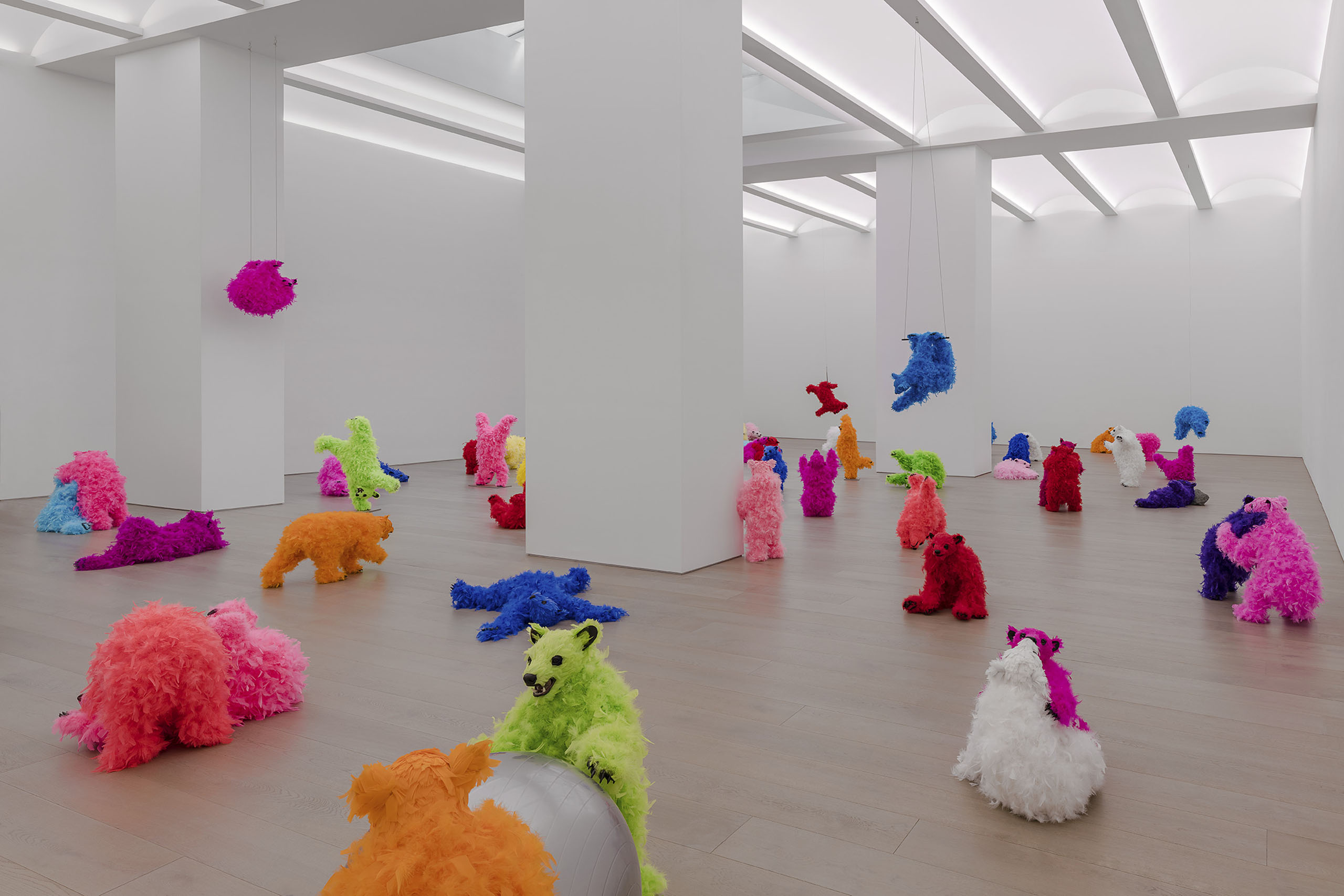
Thinking about it, growing up and becoming a mother also had an impact on my path and on this aspect. One of my works, We are the baby gang, exhibited at the Perrotin in New York in 2019, comes precisely from the aesthetics of children, which I came to know more closely when we were adopted by my son, who was five years old at the time. Those colorful little shoes at the entrance of the house, next to our big ones, are an image that changed my life.
From there the installation was born: 70 polar bear cubs covered in colored feathers, immersed in a kind of dreamlike lagoon in which viewers can move freely. This interactive space allowed people to establish with my bears a relationship they would not have with other forms of art.
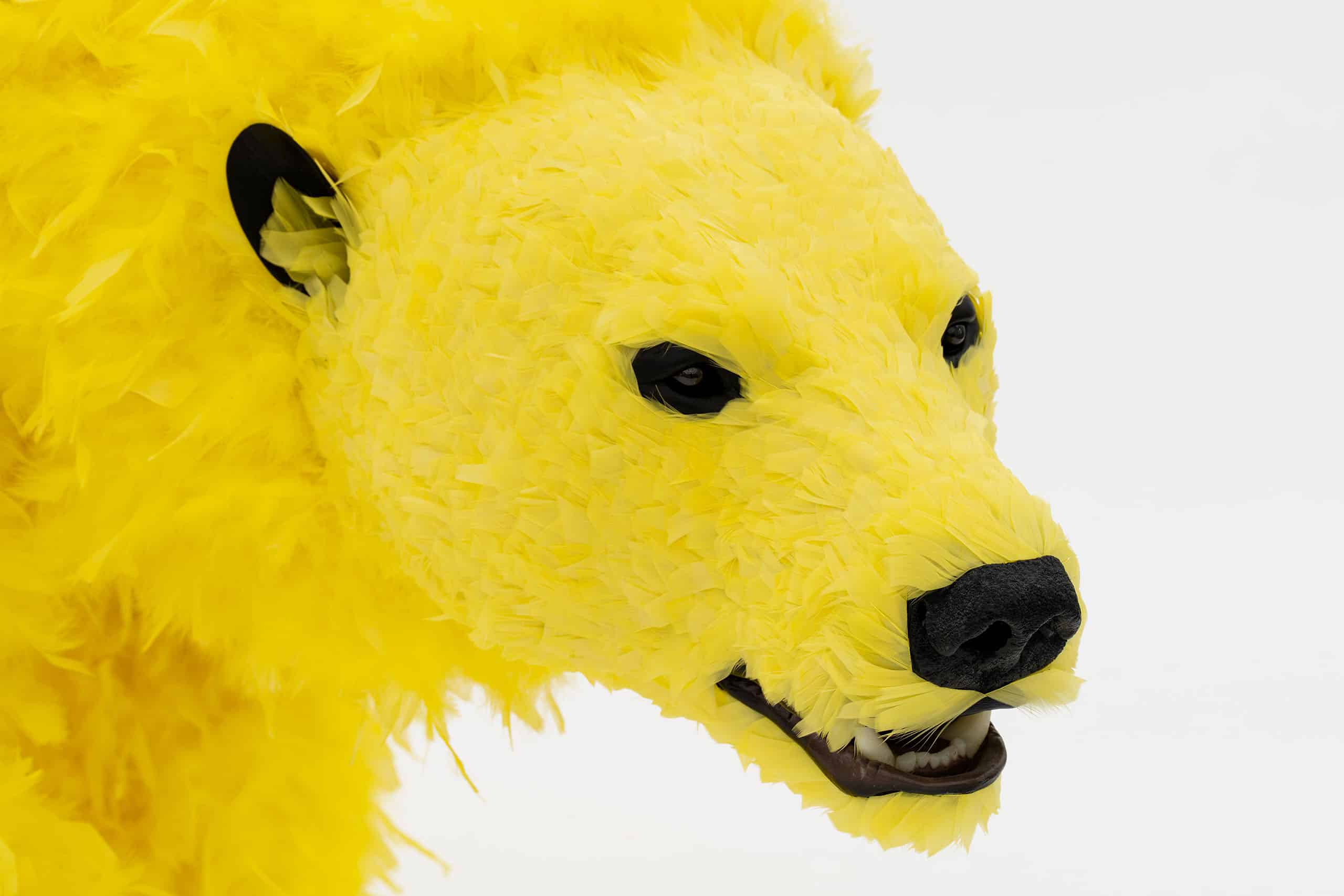
Dettaglio orso giallo, Paola Pivi, They call me Polar Bear, 2024 (dettaglio), schiuma di uretano, plastica, piume 122 x 240 x 71 cm, Fotografia di Guillaume Ziccarelli Courtesy Perrotin e l’artista
P.P.: I love art, which has always been my life and also that of my family, but I remain profoundly nomadic. I admire many artists Cuoghi, Ontani, Prini, Spalletti, Cattelan, Accardi, Manzoni, and I could name many others. I like art that is decoration for the soul, because for me there are three types of art: art that decorates the soul, art that only partially decorates the soul while also looking at purpose, and art that is only decoration for the walls.