
For centuries, we have imagined Athens like this: the Mediterranean sun illuminating the marble, the sea reflecting silver glimmers, flowing white draperies stirred by the breeze among the columns of the temples. An image of absolute harmony, so deeply rooted in our collective imagination that it seems inevitable.
And yet that city never existed.
Athens was never white.
Imagine walking through its streets on a clear spring morning. As you climb towards the Acropolis, the Parthenon dominates the city, but not with the austere whiteness we attribute to it today. Its pediments are animated by intense reds, deep blues, greens, blacks, and details in gold leaf. The statues of the gods have painted eyes, reddened lips, golden hair; friezes and metopes shimmer with colours designed to interact with the sunlight and the Aegean sky. Stone is not the final destination, but the support for a vibrant palette. Colour is everywhere: not merely an ornament, but the very language of the city.
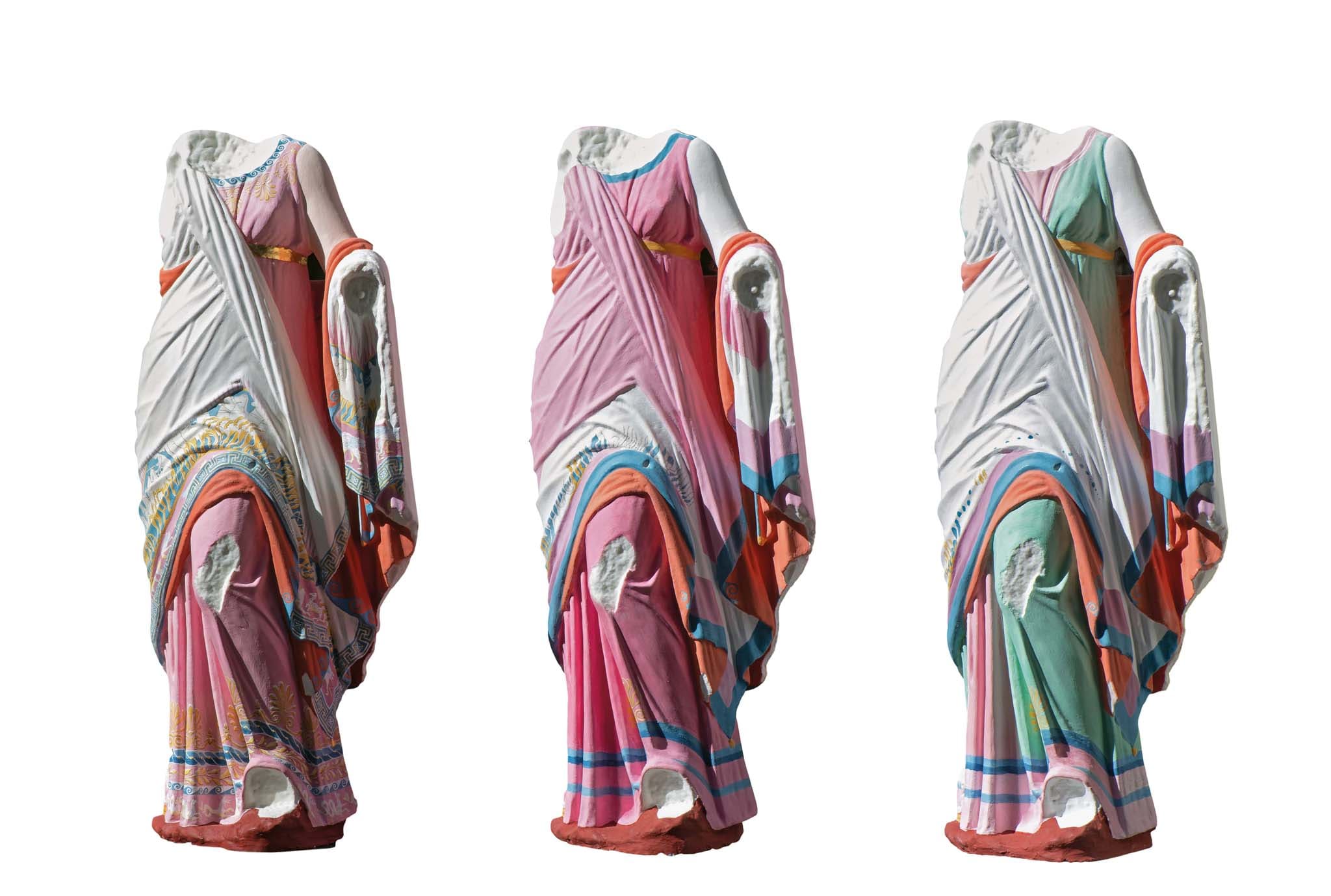
This was demonstrated particularly effectively, among other examples, by the exhibition Gods in Colour – Golden Edition: Polychromy in Antiquity, presented at the Liebieghaus Skulpturensammlung in Frankfurt between 2020 and 2021. Through reconstructions based on traces of pigment still detectable on the artworks, the exhibition restored to ancient sculptures the chromatic vitality that centuries of deterioration, restoration, and cultural interpretations had progressively erased from our collective imagination.


And yet, when we think of ancient Greece today, we see nothing but white marble.
Not because the Greeks loved white, but because history erased the colours long before it erased the stone.
For centuries, those traces of colour remained before everyone’s eyes, but almost no one wanted to see them. As early as the nineteenth century, some archaeologists noticed pigment residues on sculptures; in recent decades, techniques such as spectroscopy, ultraviolet fluorescence, and multispectral imaging have made it possible to identify them with precision. Research conducted by Vinzenz Brinkmann and Ulrike Koch-Brinkmann, together with the international Gods in Color project, has restored the original face of Greek sculpture for the public: not a monochrome universe, but a culture that made colour an essential element of its artistic expression.
And yet these reconstructions continue to surprise us. To many, they seem excessive, even kitsch. The reason is simple: for more than two centuries, we have looked at antiquity through the eyes of Neoclassicism.
The great interpreter of this vision was Johann Joachim Winckelmann. Considered the father of modern art history, he studied statues that had by then almost completely lost their polychromy and transformed that material condition into an aesthetic ideal. His celebrated formula of “noble simplicity and quiet grandeur” was not born of invention, but from the observation of works that time had already profoundly transformed. That pure white marble thus became the symbol of perfection, restraint, and universal beauty.
 Experimental study of the polychromy of the so-called Treu Head, Liebieghaus Skulpturensammlung (Liebieghaus Polychromy Research Project in cooperation with the British Museum, London), Frankfurt am Main Photo: Liebieghaus Skulpturensammlung – Norbert Miguletz Original: Italy, Rome, 2nd century AD, marble, The British Museum, London, inv. 1884,0617.1
It was the beginning of one of the most enduring cultural legacies of the West.
Antonio Canova, Bertel Thorvaldsen, Jacques-Louis David, and Neoclassicism as a whole sought inspiration in a Greece that had, in reality, already been bleached by time. Architects and urban planners did the same, spreading throughout Europe and the United States public buildings that evoked an immaculate antiquity. It is curious to recall that Canova himself, although celebrated as the poet of white marble, applied subtle patinas and glazes to his sculptures to soften the whiteness of the stone and give the skin a more natural appearance. A sign that even the greatest interpreter of Neoclassicism sensed that absolute white was more an abstraction than a reality.
The paradox is that Neoclassicism did not truly imitate ancient Greece. It imitated the Greece that had survived.
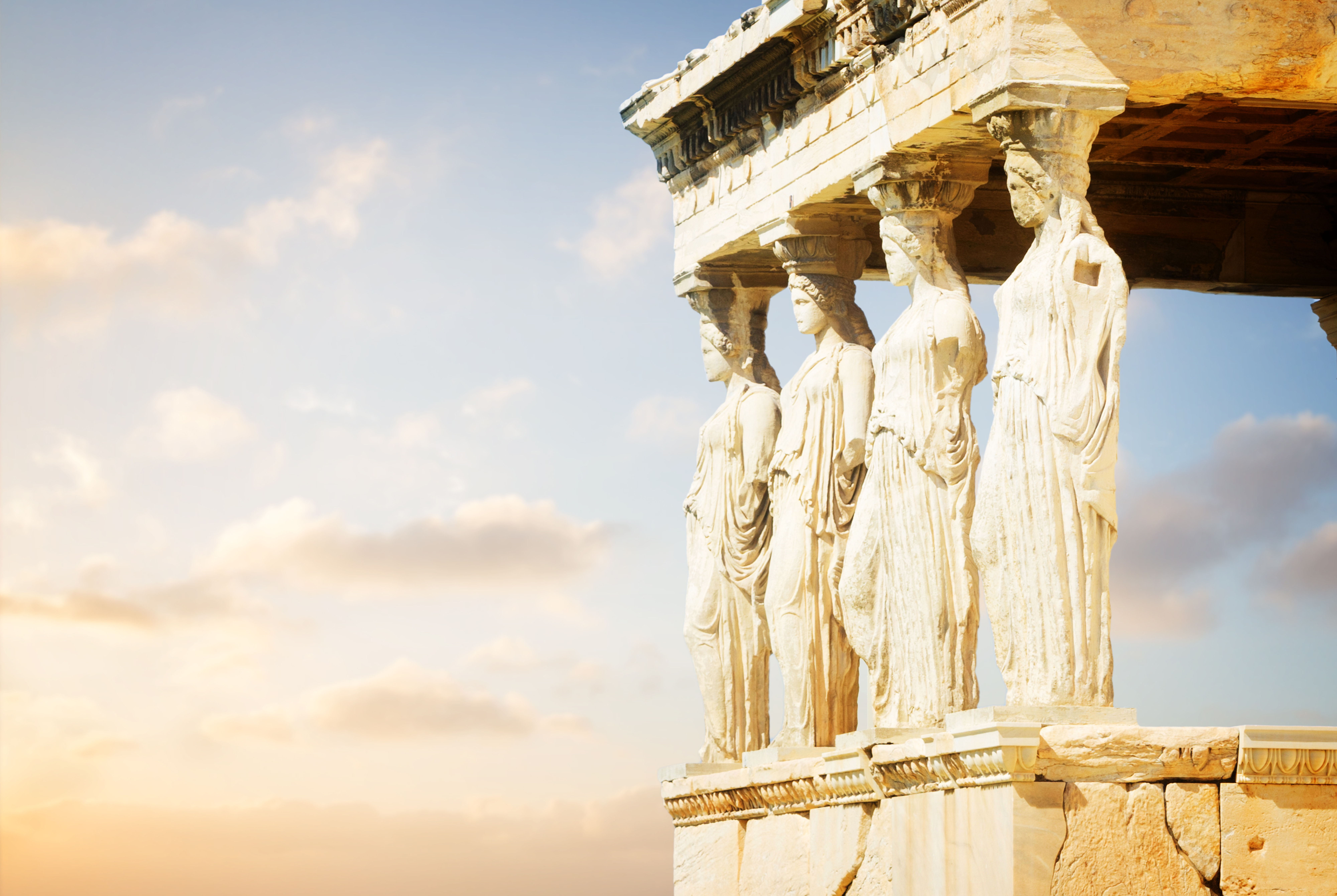
Ever since, we have continued to look at the Acropolis through that same lens. White has become synonymous with order, balance, purity, and perfection; colour, on the other hand, has been relegated to an archaeological detail. And yet, if the Greeks could observe our reconstructions of antiquity today, they would probably be as surprised as we are when confronted with the polychrome reconstructions of their statues.
 Experimental colour reconstruction of a statue of a woman wrapping herself in a mantle, the so-called Small Herculaneum Woman, 2019, Liebieghaus Skulpturensammlung (Liebieghaus Polychromy Research Project), Frankfurt am Main, inv. LG 223 (on loan from the Goethe University Frankfurt, Institute of Archaeological Sciences, dept. I: Classical Archaeology, cast collection) Photo: Liebieghaus Skulpturensammlung – Norbert Miguletz Original with polychromy: Delos, 2nd century BC, marble, National Archaeological Museum, Athens, inv. 1827
“The purest and most thoughtful minds are those which love colour.” — Thus wrote John Ruskin in The Stones of Venice, almost a century after Winckelmann.
Perhaps Athens never truly lost its colours. It was history that consumed them, while the West transformed that loss into an ideal of beauty. We ended up confusing what remains with what once was.
White marble is not the colour of antiquity. It is the colour of its memory.
Perhaps the greatest masterpiece of Neoclassicism was not a sculpture, a building, or a painting. It was convincing us that perfection was white. The ancient Greeks, instead, had chosen colour.

Main sources: