Born in Paris into a family of artists, he grew up crossing his mother’s textile studio on the way to school, unconsciously absorbing those creative, social, and environmental values that now permeate his practice. His work, however, never indulges in softened rhetoric: it is a direct, incisive investigation, rooted in a cultural legacy that combines the visceral improvisation of “making” with a conceptual reflection on contemporaneity.
Often working with domestic archetypes such as chairs and tables, Orta pushes them beyond the threshold of everyday use; what seems destined to accommodate the body or organize space transforms into sculpture, retaining the memory of its function while simultaneously disarming it to make room for meaning. His works explore the unresolved tension between nature and industry, evoking a dialogue between the fragility of the organic and the hardness of the artificial through biomorphic forms and tactile materials. As he himself suggests, these objects resemble beings in metamorphosis, suspended between hyper-worked artifice and the decay of consumerism.
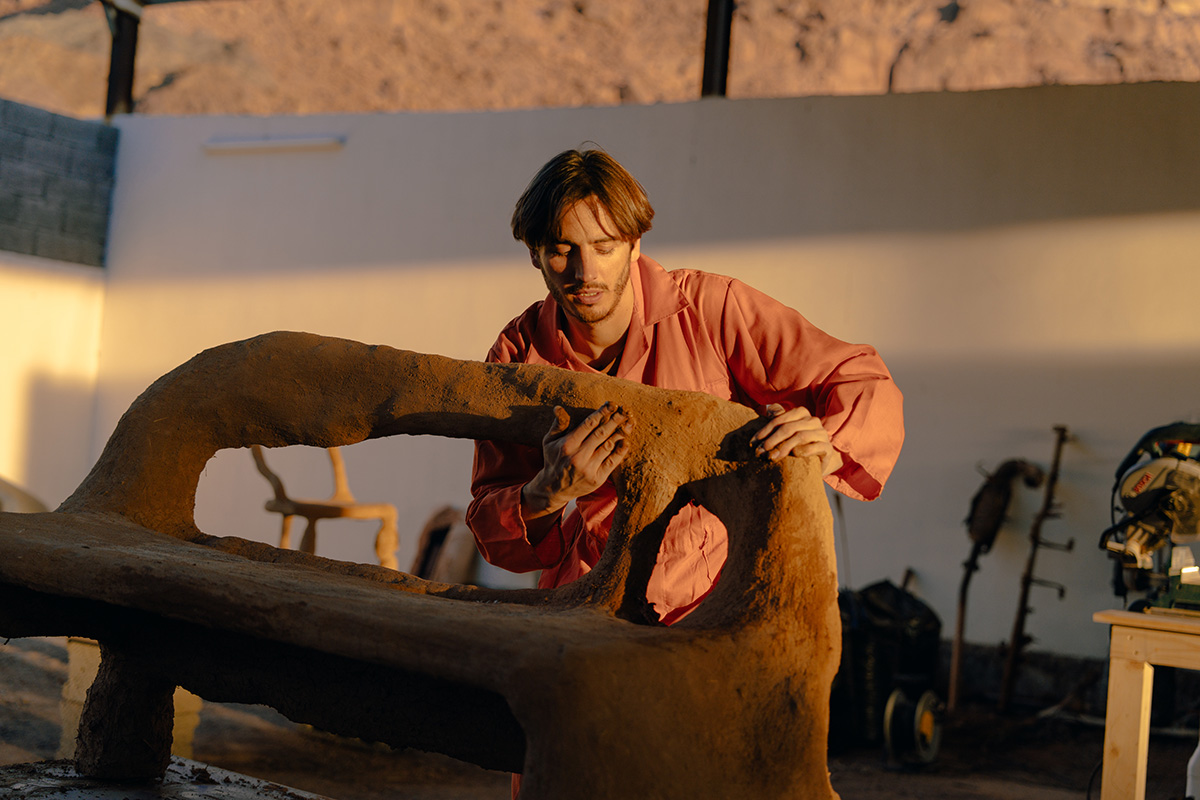
This research has found new momentum in the recent and prestigious residency in AlUla, Saudi Arabia, where Orta embarked on a creative direction that marks a return to the primary gesture: the use of local materials such as mud, straw, palm fibers, and natural pigments has shifted the focus from experimentation with industrial waste to a more ancestral language, where the act of building and kneading precedes design itself. In this interview, the artist opens up generously, guiding us through a universe made of memories and reflections on sustainability, inviting us to question what truly makes a place inhabitable and where utility ends and symbol begins. Through his account, the distinction between art and design becomes porous, turning into a necessary opening through which to rethink our relationship with space, matter, and collective responsibility.
For those who wish, it will also be possible to meet him in person at MIART at Andrea Festa Fine Art.
My family played a fundamental role in my artistic development. I grew up in Paris, the child of two artists, and as a child I would cross my mother’s textile studio every day on my way to school, also helping my father with his paintings during the summer. This environment immersed me in art and in the social and environmental values transmitted by my parents, even if, as a child, I did not always appreciate it. Only later did I understand the value of the experiences they gave me, such as following their exhibitions around the world or climbing volcanoes and pyramids with my mother.
My Anglo-Argentine roots helped shape a multicultural outlook, although living in France for 25 years sometimes made me feel suspended between different identities. This sense of not fully belonging pushed me to travel and explore other cultures, which are now an essential part of my artistic practice. I enjoy discovering the ways other traditions produce and create, combining everything like a recipe that surprises.

I found my path at the Design Academy Eindhoven, where I discovered the strength of both manual and conceptual experimentation. I came from an initial path in Graphic Design between London and Brussels, where I felt uninspired. In Eindhoven, instead, I was able to freely explore my interests: from social projects to collaborative work, all the way to performance and experimental design.

In my practice, I learned the fundamental principles of design, such as ergonomics, proportions, and assembly techniques. These serve as a foundation to ensure both functional and formal balance. However, at the beginning of my journey at the Design Academy Eindhoven—especially while working as a duo—I was fascinated by the idea of ignoring some of these rules in order to explore new territories of material and aesthetic combinations.
I enjoyed leaving space for improvisation, like in jazz, allowing mistakes to open new opportunities—sometimes a real process of learning in the field. At the time, I did not yet know how to use digital tools like 3D rendering, so I started from quick sketches and allowed the dialogue to happen between the materials and my mind. Now, after years of experience and the opportunity to work with craft studios and 3D technologies, I still firmly believe that unpredictability and intuition are essential to the creative process.

I am deeply connected to the manual dimension and I love making things. I learned many techniques as a self-taught practitioner, watching online tutorials or studying processes explained by companies. Only in the last two years have I begun collaborating with artisans or specialized companies for works that required techniques I could not achieve alone, such as glass blowing, castings, or complex chemical processes.
I started in a small bicycle garage, moving from one student space to another, working in my spare time between school and experimentation. I was inspired by techniques from the film and decorative industries, as well as memories of my parents’ sculpture studio, where inexpensive materials were used for prototypes: papier-mâché, plastic bottles, and hot glue. From there I understood that there was an infinite possibility of expression beyond academic methods, which often seemed repetitive to me.

My approach has always been guided by the question: “How can I achieve this form with this material?” and by testing its limits. For example, the first experimental work with OrtaMiklos involved mixing poured concrete with stockings and embedding braided cables, revealing the internal structures of construction materials. Everything was easily found in hardware stores or scrapyards.
I see techniques as a “toolbox”: you learn enough by practicing them, adding them one at a time, until you understand how to master and apply them. Today, after facing some health problems, I am reassessing my approach: I collaborate more and more with well-equipped companies and experiment with more sustainable materials or low-impact techniques. This allows me to produce in a way that is more conscious and suited to the contemporary world.
I also love working outside the studio, especially when traveling, in order to learn new artisanal techniques such as weaving or mud-brick making.

My work feeds deeply on the art of others. Observing works in museums inspires me and helps me understand how artists have shaped not only history but also their own practice. Henry Moore fascinates me for his ability to transform the body from figurative to abstract. Niki de Saint Phalle captivates me with her imaginative universe of monsters and spiritual beliefs. Artists such as Phyllida Barlow, Isamu Noguchi, and Germaine Richier strike me for their sensitivity to nature, materials, and the political dynamics of their time.
In the end, it is true that Surrealism in particular represents for me a way of interpreting—or escaping—social and political reality, an attitude that still feels relevant in an era of global crises. Exhibitions such as Surrealism at the Pompidou or Atomic Age at the Musée d’Art Moderne in Paris showed me how every artist faces the challenges of their time with different languages. This comforts and inspires me.

Very much so, and it entered my path precisely through the influence of Surrealism, which explored dreams and thoughts of the subconscious. Reading British Surrealism by Michel Remy, I discovered the concept of Psychorealism by Grace Pailthorpe and Reuben Mednikoff, who combined mental analysis with artistic creation.
This approach made me reflect on the regenerative power of art, an idea I also deepened while studying my great-aunt Emmy Bridgewater, co-founder of Surrealism in Birmingham. During a period of burnout, I undertook Gestalt therapy to confront fears and behaviors that I thought might be linked to hereditary conditions such as bipolar disorder. At that moment, I discovered how to channel intense emotions—anger, fear, frustration—through art.

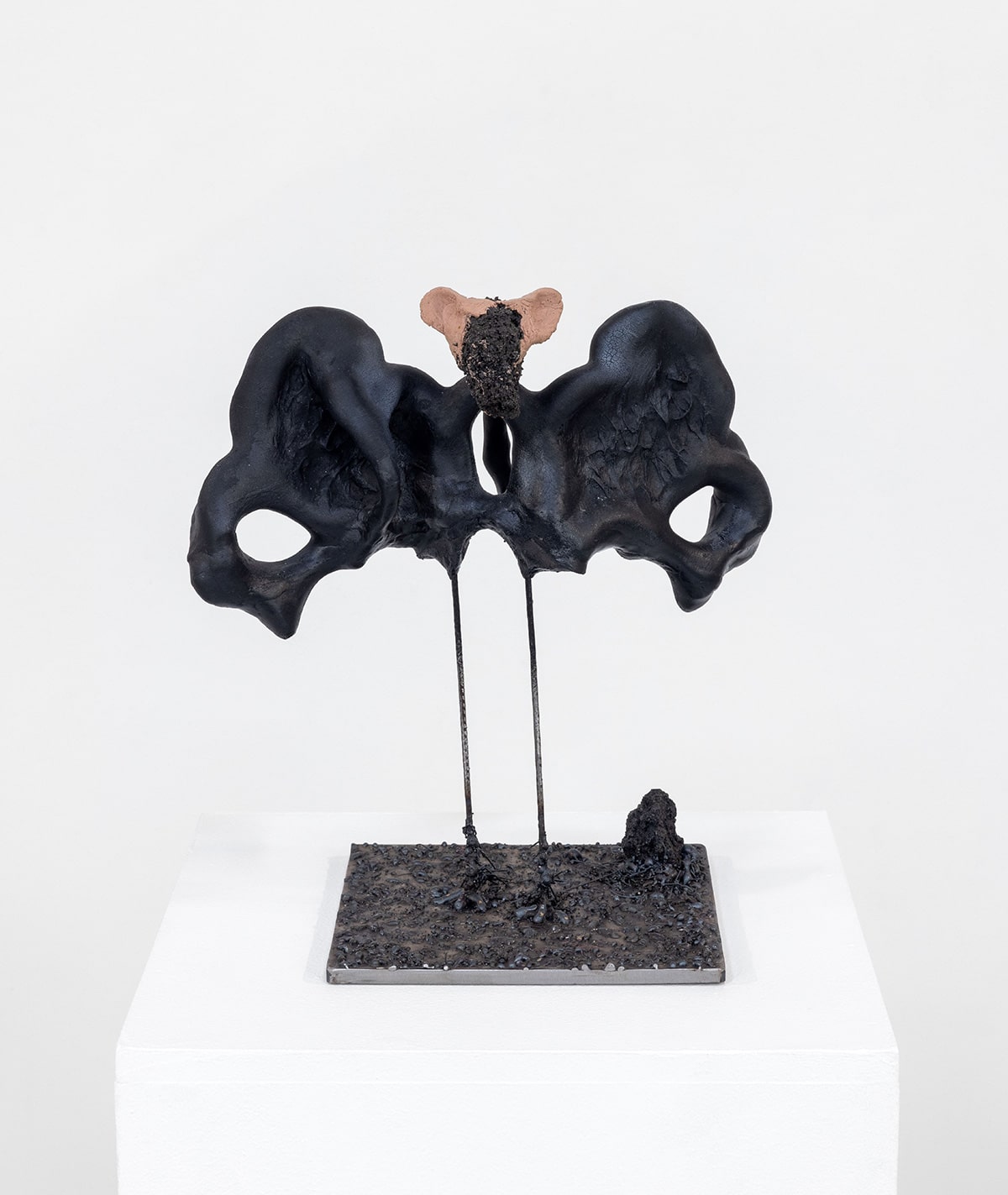
Thinking about it, Phoenix is a work that became a real object of healing for me. I felt as if I were burning from within, a process of self-destruction that I translated into forms and colors. The Phoenix armchair represents rebirth, inspired by Gaston Bachelard’s thought about fire as a symbol of transformation and by Heraclitus’ concept that fire is both an end and a beginning.
The work depicts the skeleton of a bird rising from the ashes, a symbol of regeneration. For me, it was a way to transform pain into a creative act, turning fire into not only a destructive force but also a source of rebirth and hope.

My first encounter with reclaimed industrial materials happened in the Netherlands, in front of a gigantic dump of cables. Instinctively, I climbed on top of it, becoming trapped like an insect among the waste. Then I imagined myself as a spider, capable of weaving new networks and narratives.
From that moment I began exploring the composition of objects—clothes, electronics, consumer goods—and their life cycle, often closer to waste than to reuse. A visit to a sorting company was illuminating: unsold clothes from second-hand shops were redistributed across Europe, Asia, and Africa, but many still ended up burned or in landfill, impossible to recycle because of poor quality or mixed fibers. In India, even single shoes were shipped in the hope of eventually finding the missing pair.
This research inspired a performance with OrtaMiklos in which I transported a 1.5-meter cube of clothes through the city, evoking Michelangelo Pistoletto’s Sphere of Newspapers. It was a symbolic gesture to question circularity, waste, and our responsibility as creators.

Definitely an unresolved tension. My works resemble “living beings” in continuous evolution, suspended between nature and industry. These organisms are in a state of metamorphosis, reflecting our contemporary world, which oscillates between hyper-worked structures and the decay of consumerism.
Biomorphic forms and tactile materials recall the fluidity and adaptability of nature, while synthetic elements introduce rigidity and intrusion. This duality explores the ambiguity of their relationship: are they merging harmoniously, or is one prevailing over the other?
I avoid using “green” materials just to appear responsible. When I choose bio-based materials, I try to understand their origins, the producers behind them, and the message I want to convey. I am increasingly focusing on local materials, collaborating with farmers and producers near my studio to develop systems that enhance fibers, earth, pastes, and cellulose.
I often speak about the role of plastic, an inevitable presence in our lives. We cannot eliminate it, but we must learn how to manage and use it consciously. I try to express this complexity through materials and colors that evoke disgust, fear, or attraction, as in the case of tarama: its bright pink attracts us, yet it is a chemical color that hides its natural reality.
Another source of inspiration is the IUCN list of endangered or extinct species, which helps me reflect on the diversity and preciousness of life. The colors, forms, and adaptations of these creatures influence the creation of my hybrid beings between flora and fauna. I do not try to provide definitive answers, but rather to raise awareness, stimulate reflection, and inspire change.

It is a bit of all three, in a natural rather than deliberate way. Industrial waste materials attract me because of their history: they have already had a function and carry a past with them. In this sense, it is an act of memory, preserving and reinventing what has been discarded.
But it is also transformation. When I combine these materials with biomorphic forms, I create a new identity that merges the artificial and natural worlds, raising questions about our relationship with industry, nature, and the body. Finally, it is resistance. I reject the idea that what is “exhausted” has no value anymore. Recovering and reinventing materials is a rebellion against the culture of disposability.
However, the process is guided more by curiosity than by planning: I explore the tension and harmony between these elements and allow the work to guide me.
Design responds to a theme, offers solutions, and proposes new perspectives. It is functional, but it can also be conceptual, decorative, or innovative. I use it to inspire, to transport people into imaginary worlds, to furnish spaces, and to share knowledge.
However, these same principles are reflected in my artistic practice. I have learned to move between art and design, finding a balance between the two. Today I consider myself both a visual artist and a designer, capable of moving between functional and experimental projects.
A sculptural chair, for example, remains a chair if it retains its function—45 cm seat height, a 3° backrest inclination, tested ergonomics—but it can also address social, political, or environmental issues. This fusion invites the public to reflect, moving beyond the boundaries between aesthetics and utility.

My works arise from discoveries made along the way: field trips, conversations with philosophers and activists, all woven together into cohesive forms or assemblages. They are layered, and I hope the audience can perceive some of these nuances through paintings, films, or photographs that reflect my experiences.
However, I believe it is essential to leave space for personal interpretation. It is important to provide context, but also to stimulate questions and reflections. Emotions are very personal, and it is important that every viewer can reveal their own sensitivity toward a work.
I often think about my friends who are not part of the art world, who visit spaces like the Palais de Tokyo and complain about the difficulty of understanding or connecting with the works. It is important to communicate with a broad audience without decontextualizing the work or reducing it to mere entertainment.
Through the words of Emmanuel Coccia and Andreas Weber, I see sensitivity as a competence to cultivate in order to understand how we live on Earth and the stories we leave behind.
An example that deeply moved me was the installation by Anselm Kiefer at the Grand Palais Éphémère in December 2021, which managed to transport me into his emotions, making me feel pain, disorientation, and sadness.
Linen, without a doubt. Near my studio there is a factory that produces different qualities of linen, run by a third-generation family that cultivates and processes this resource for the construction, textile, and insulation sectors.
I would like to explore linen in its raw and untreated forms, transforming it into woven surfaces, padding, or cellulose pastes. My recent residency in Saudi Arabia, where I learned the art of mud bricks, motivated me to seek artisans who work with linen in different applications. For me, this material represents a connection between tradition and innovation.
The interview with Leo Orta marks a new chapter in L’ARTE IN PRIMA PERSONA, a project promoted by CRAMUM together with Schiavi SpA, under the artistic direction of Sabino Maria Frassà.