The construction sector** has long been at the heart of a heated debate on sustainabilityAs is known, in fact, the construction industry is among the most energetic** and with high environmental impact, with cement that alone contributes to about 8% of global emissions In a time when ecological transition is a priority, the Commission has been research for innovative materials The new building was made of the greenest city and** the greenest city of the city. More resilient buildings • The 3D printing applied to buildings is undoubtedly emerging**, a technology that has the potential to reduce waste material, speed up construction times and, in the future, improve the energy efficiency of the entire building process. However, for this technique to really impose itself on a large scale, it is essential to ** develop** materials high performance The newest innovation in the field of construction materials is included in this context: **a new concrete • eco-friendly for the construction of the building materials. ** 3D printing, developed with an advanced formula that promises to revolutionize the industry. More durable, less environmentally impacting and designed to meet modern building standards, this material moves a significant step towards a more responsible and cutting-edge building.
The challenge of traditional concrete The concrete is undoubtedly the most used building material in the world. Versatile, durable and relatively economic, is still at the base of most modern infrastructure, from housing to bridges, to skyscrapers and public works. However, behind this widespread diffusion there is a vast environmental criticality: as indicated, the concrete production, key component of concrete, is one of the activities that most produce global emissions of CO2. This high ecological footprint derives mainly from the process of calcination of limestone, which requires high temperatures and involves the release of large quantities of carbon dioxide. Moreover, the extraction of raw materials, water consumption and massive energy use contribute to making concrete one of the ** materials less sustainable** from an environmental point of view. Despite these limits, its replacement with completely cement-free alternatives is still complex, since no other material has yet equaled its characteristics of resistance, durability and versatility on a large scale. The real challenge, therefore, is not to eliminate it, but rather to make it more sustainable**.
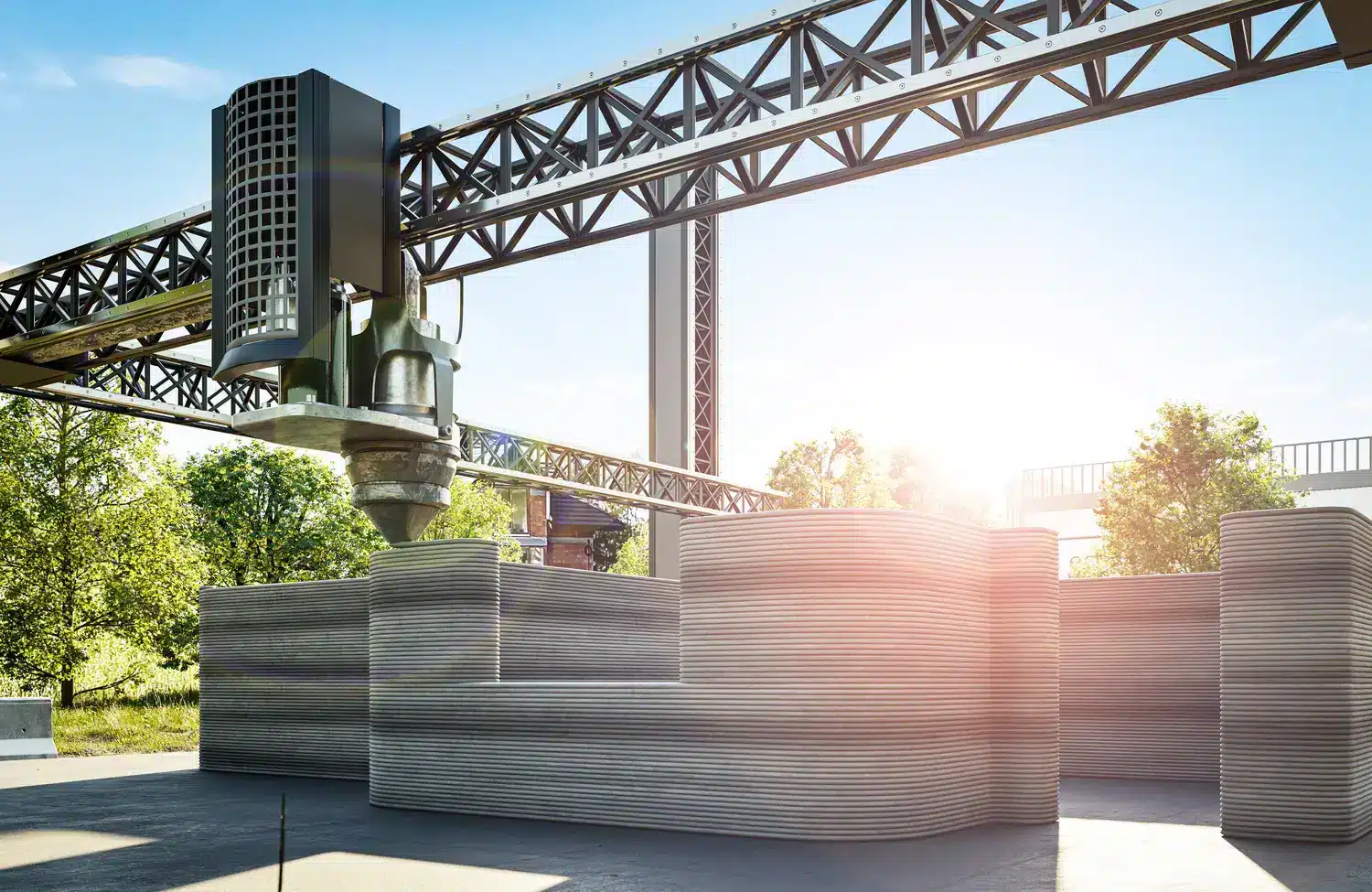
In this light, scientific research has long concentrated its efforts on the formulation of new mixtures of low environmental impact concrete, which are capable of reducing emissions without compromising structural performance**. The use of innovative components, such as recycled materials, alternative binders or technological additives, seems to be a promising way to reduce the climate impact of the building industry and inaugurate a new era for the sector. The introduction of 3D printing applied to construction is an additional opportunity to improve the efficiency of the use of concrete, minimizing waste and reducing the need for traditional formwork and moulds. However, to exploit its full potential, it is essential to develop more advanced materials that guarantee durability, durability and sustainability at the same time. In response to these needs, the new eco-engraving for 3D printing is born, the result of careful research that combines innovation and respect for the environment.
Eco-friendly concrete: innovation comes from the University of Virginia To face the challenge of the environmental impact of concrete** without compromising structural resistance, a team of researchers from the University of Virginia (UVA)** developed a new material**](https://engineering.virginia.edu/news-events/news/advancement-3d-printed-concrete-promises-strength-durability-and-lower-carbon-emissions) which could redefine the standards of the 3D printing in construction. innovative formula is based on an advanced mixture of graphene, limestone and cement of calcinated clay, designed to improve the mechanical performance of the concrete while reducing its carbon footprint. In particular, the key to this innovation is the graphs, a material known for its exceptional properties of resistance and conductivity. Integrated in the cement matrix, graphene contributes to reinforce the concrete at the molecular level, increasing its capacity to resist mechanical stresses and improving its durability over time. Its presence in the dough also allows to reduce the total amount of cement necessary to achieve the same structural performance, ** thus reducing the CO2 emissions** typically related to the production of this material.
The lime clay is a good alternative to traditional cements, since it offers a high resistance and greater sustainability** compared to the clinker, the most impacting component of Portland cement. Combined with limestone, its use helps to improve the workability of the material and to optimize its ability to be printed in 3D with precision and stability. Thanks to this combination of elements, the new eco-structure for 3D printing offers an ideal balance between sustainability and mechanical performance, opening up new possibilities for the** construction of the future**. If adopted on a large scale, this technology could not only reduce the environmental impact** of the construction industry, but also increase the reliability and efficiency of the 3D printing in construction**.
The advantages of eco-concrete for 3D printing The innovation developed by the University of Virginia is intended to be a concrete solution with measurable advantages. Specifically, the new eco-concrete for 3D printing is distinguished by two fundamental aspects: better mechanical performance and reduction of environmental impact.
Higher resistance and durability One of the main limit of 3D printing in construction is the resistance of the material used. Although this technology allows structures to be built faster and with less waste of resources, traditional 3D printing concretes often ** do not guarantee the same mechanical performance** as mixtures used in conventional construction. The new mixture developed by the UVA solves this problem thanks to the aforementioned presence of the graphene, which gives the material greater resistance to compression and better capacity to absorb mechanical stresses. This advantage results in a higher durability over time, as well as in reducing the risk of cracking, deterioration and maintenance needs. The lime clay and limestone also improve the cohesion of the mixture, optimizing the stability of 3D printed structures. Thanks to these characteristics, the new concrete could enlarge the scope of 3D printing in building, transforming it into a solution suitable for both experimental projects and more complex and durable infrastructure.
Reduced environmental impact In addition to technical performance, the mixture developed by the University of Virginia stands out for its reduced environmental impact**. Resilient and Advanced Infrastructure Laboratory They have shown that this new formulation ** reduces greenhouse gas emissions by 31% compared to traditional 3D printing concrete**. In addition, the** Life Cycle Analysis (LCA)** has shown that the partial substitution of cement with calcinated clay and limestone significantly reduces CO2 emissions generated during production. Finally, the use of this concrete in 3D printing promotes a more efficiency in the use of material, reducing waste and consumption of natural resources. This, combined with emission reduction, makes the new concrete a more sustainable and compatible solution** with the ecological transition objectives of the construction sector.
What practical applications for sustainable concrete? To test the potential of the new eco-based concrete for 3D printing, the research team of the University** ** of Virginia** has collaborated with the Virginia Transportation Research Council (VTRC), an institution specialising in the development of innovative solutions for transport infrastructure. The partnership has allowed ** to test the material in real contexts**, assessing its resistance, durability and compatibility with the needs of modern public works. The use of innovative concrete in infrastructure is an ambitious ** challenge**, since transport facilities such as bridges, road barriers, sidewalks and signpost supports must necessarily ensure high resistance to atmospheric agents, dynamic loads and wear over time. The tests carried out in collaboration with the VTRC have shown that this new mixture is able to meet these requirements, proving to be a more sustainable and high-performance construction solution. However, the adoption of the new material could revolutionize not only the infrastructure sector, but also other areas of the construction industry. Thanks to the A combination of resistance and reduced environmental impact, the eco-concrete for 3D printing could be used in a wide range of projects, including:
- Transport infrastructure: Creation of prefabricated bridge elements, safety barriers and support structures.
- ** Residential and commercial building**: construction of buildings with complex geometries, difficult to achieve with traditional techniques.
- ** Urban spaces and public furniture**: production of custom architectural elements, such as benches, shelters and facade coverings.
- ** Zero impact buildings**: development of energy-saving optimized structures, integrating advanced materials for the improvement of thermal insulation. The use of 3D printing in building, supported by more sustainable and performing materials, could lead to faster construction times, lower production costs and a global reduction of CO2 emissions**. In addition, the possibility of personalising design in a precise and waste-free manner opens up new perspectives for the sustainable architecture of the future.
Thanks to these advances, the new concrete could ** accelerate the adoption of 3D printing in the construction sector**, transforming it from experimental technology to concrete and competitive solution for tomorrow's infrastructure. The commitment of scientific research** is, therefore, essential to transform the way in which cities of the future are designed and built: thanks to solutions like this, the building has the opportunity to evolve in a more responsible way, combining ** technological innovation and environmental needs**.
To view videos, enable external content in your cookie preferences.