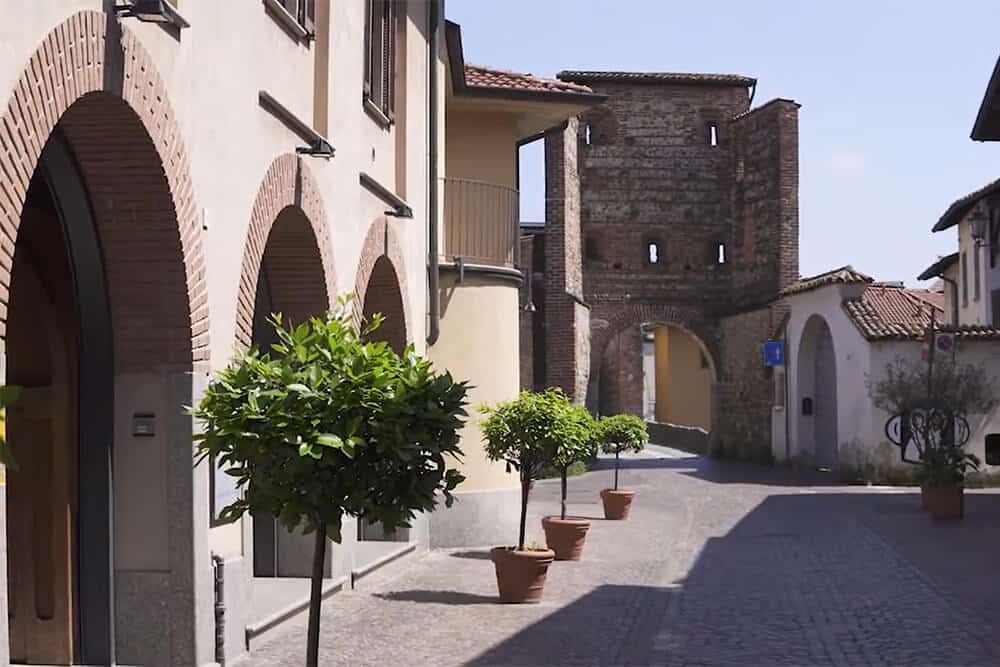
Summer is a great time to visit the Brianza**, explore the hidden angles, discover the history and relax in the numerous natural areas that it offers. The brianzoli villages are particularly interesting and the entire territory, by its very diverse nature, has without a doubt parecchio to offer.
** Vimercate** is among the municipalities that most meet ** the liking of citizens and visitors**, both for its proximity to the cities of Milano and Monza that for the many surprises he reserves.
The town, of just over 25 thousand inhabitants and including the fractions of Oreno, Velasca and Ruginello, is in fact considered the "jewel" of the Vimercateese Brianza** also thanks to its close proximity to the locals Parco del Molgora and Parco Gussi (in which there is the villa of the same name), perfect for some relaxing hour in the green.
A rich historical and architectural heritage in a village to discover A visit to Vimercate It should certainly consider the numerous places of interest that the municipality makes available to citizens and tourists**. The first of these is the rural church of Santa Maria Assunta in the hamlet of Ruginello, documented already by the end of the XIII century and characterized by a prily Romanesque style. Inside, it is worth a look at the numerous frescoes \ About ten, all realized between the fifteenth and sixteenth centuries, and among which deserves a special mention The Mystical Bride of Saint Catherine.
♪ Sublime** ♪ In the artistic sense of the term is also the eighteenth century Death of Ruginello, in the nearby Via Diaz: on two panels are portraits two skeletons, one holding an hourglass, the other a sickle. This original work of macabre art** is then composed of four pillars whose trophies are represented by skulls, and card bearing the words "Hodie mihi, cras tibi" (Today to me, tomorrow to you).
From Via Diaz you can take via Independence and reach Piazza Addorata, where stands the eighteenth-century Oratory of the Sorrowful** with its splendid ** Baroque face**. Inside, the building boasts a valuable series of paintings depicting the stations of the Way of the Cross.
As for the historic villas to see in Vimercate**, noteworthy is certainly Villa Besozzi (also known as Villa Lorenzini), once again eighteenth century and inspired by the Baroque style**. In addition to being architecturally relevant, the building is located in an exclusive and panoramic position**, completely immersed in a luxuriant Italian garden**, as well as flanked by the historical Chapel of St. James and St. Christopher.** It is then worth mentioning Villa Gallarati Scotti, which is located in the homonymous church of St. James and St. Christopher.** It is also worth mentioning Villa Gallarati Scotti via: it is a ** building with a large U-shaped court** and typically neoclassical shapes, designed by the same architect Simone Cantoni who took charge Villa Perego in Inverigo. The nearby neighbor is also spectacularNymphaeum of the Neptune, a baroque building with terrace view** and pleasant fountain that takes up the theme of the god of the sea, here depicted standing on a dolphin.
Even older is the Casino di Caccia Borromeo, made in the Three hundred and characterized by a particular mason of pebbles with fishbone. Inside the nearby tower, which dates back to the mid-th century, it is possible to admire a cycle of frescoes considered among the most important manifestations of Profane painting of the period.
Near the Casino di Caccia there is also the spectacular Cascina Lodovica**, a farmhouse in typical Lombard style** on whose summit are still visible today ** several Borromei rings**, symbol of the family once owner of the building.
Finally, the most interesting are **Palazzo Foppa**, whose current configuration dates back to the 17th century** and which shows, at the level of the porch, **three arches with a lower sixth** Francesco d'Assisi: dating back to the first half of the thirteenth century** and today built on **500th century**, it is said that he was **visited even by the saint himself**. **A curiosity to conclude**: the entire territory of Vimercate is also historically rich in farmhouses and rural dwellings.** A 1950 census** included forty-one of them, all inhabited. Clearly, with the gradual abandonment of agricultural activities it occurred also **the inevitable decay of many buildings** . .. or simply the change of their destination. However, still today there are about a dozen farmhouses** characterized by a large use of **baked brick**, one of the typical materials of the area. These include the following:*Cascina Castellazzo, Cascina Casiraghi, Cascina Cavallera, Casineta and Cascina Grifalda**.To view videos, enable external content in your cookie preferences.