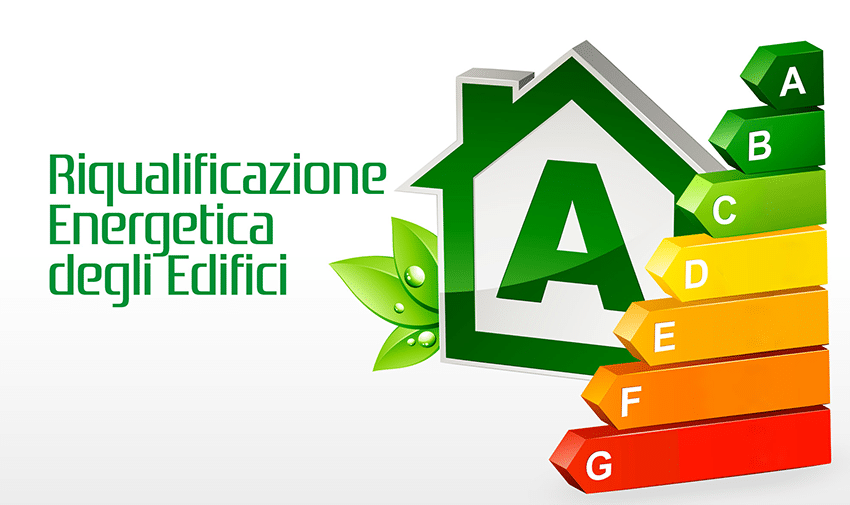
In the context of the work of ** energy redevelopment** that we at Schiavi Spa have carried out on a ** pre-existing building in Arese**, particular attention has been paid to the fundamental factor of thermal insulation. The premise to be made on this is relative to the boom of the building in Italy after the Second World War, when the lack of technical knowledge in the matter of energy savings combined with the lack of environmental sensitivity led the country to acquire a ** extremely poor building heritage** from the point of view of energy performance. At the time, the common custom in building was to build houses in a very simple way, which provided almost exclusively for ** low-thick walls** composed of the only supporting structure and the perimeter buffers. The marked reversal of trend that we are witnessing is rather relatively recent: climate change now impossible to ignore, combined with the awareness that a well-insulated building is equivalent to a lower expenditure in bills, have gone hand in hand with an evolution of the building. This is why new materials and new techniques are introduced in the construction processes with the aim of creating ** ever more efficient houses.** The traditional building envelope has undergone a mutation: it has become indispensable, even from a regulatory point of view, to equip the building not only with its supporting structure but also with an insulating layer** that can prevent the dispersion of heat accumulated in winter and the overheating during the summer.
The most common application of the insulated layer is called a coat* , and consists of covering the entire wall structure of insulating material. The coat solution can be of two types: external, when the material is placed in contact with the external surface of the masonry; internal, when the insulation is applied directly to the wall in contact with the rooms of the house. What is important in the insulation is the continuity of the material along the entire perimeter of the building: in fact, a few disruptions points are sufficient to frustrate the entire work done.
In this sense, therefore, the outdoor cappot is more effective because the insulation runs through the entire building avoiding any kind of interruption. On the contrary, the inside cappot risks to prove less efficient because, moving from floor to ceiling, inevitably involves frequent interruptions in correspondence with the floors: that is why it loses its effectiveness!
In its ** renovation of the Arese building**, Schiavi Spa has first carefully analyzed the state of the property, and then opt for the realization of an outside ** coat** able to create a continuous envelope that would cover the entire perimeter of the building. This ** insulating envelope**, made of expanded polystyrene, was then placed in continuity with the insulation of the roof. In this way it was possible to guarantee the continuity of the insulating material on all faces exposed to the building, thus making clear the problem of the
From a functional point of view, the solution we adopted was extremely effective. Moreover, the design of this type of insulation also brought undeniable aesthetic advantages, because the exterior of the building was thus subjected to a real restyling. A smart strategic choice has created a connube between style and performance: the building, finally isolated to perfection in its interiors, was plastered outside a new, aesthetically more pleasant and capable of communicating, with its image, also the quality level that had finally reached. Here is how careful intervention in terms of thermal insulation has meant that a building old in appearance and poor in performance would become a modern house, in which wellness, comfort and energy savings are combined perfectly giving life to a long-term economic savings.
To view videos, enable external content in your cookie preferences.