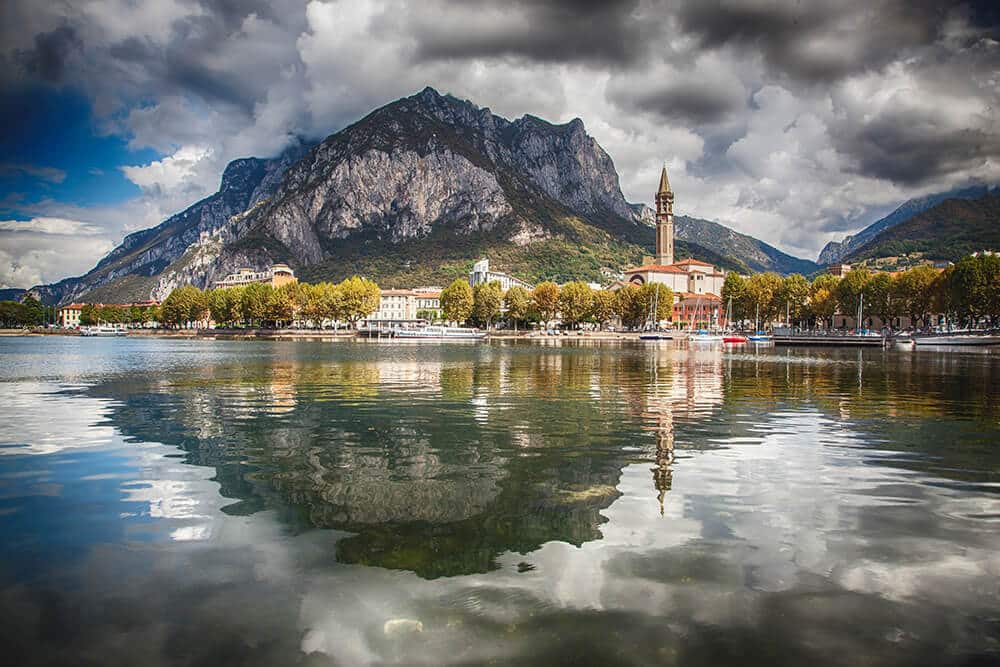
The city of Lecco** is recognized and appreciated above all ** the excellent quality of life** and the high geographical location, in exceptional position Between lake and mountains. These are two characteristics so worthy of note that they are, very often, more than enough to ** choose to live in them** , or at least to opt for the small municipalities that surround it during the search for a house**. However, Lecco is much more than a pretty Lombard town where you can live, work and have fun without having to move beyond its perimeter: it is also a place from the old and exciting history, which has seen it go from fortified village to the modern and comfortable micro-metropolis that we all know.
The panoramic city of Lombardy is inhabited forever As mentioned in the opening article, to make Lecco one of the most attractive cities in Lombardy for those who are looking for a dwelling is first and foremost the particular geographical location.
Considered the location panoramically more attractive than the entire Lake Como , more precisely, its branch of Lecco , overlooking a large mirror of blue water surrounded by mountains such as the Resegone, the Due Mani and the San Martino, giving rise to a delicious microclimate at almost every time of the year.
The pearl of Lombardy is, perhaps for this very reason (as well as the considerable availability of natural resources and the interesting position of junction towards the north), inhabited even in prehistoric times: some excavations carried out in 1988 have led to the discovery of reperts related to the first Iron Age.
The first real housing settlements, however, are almost certainly to be referred to the celte and Gothic populations • the latter placed above all on the Lecchesi highlands and in the area of the Barra Plains • in a leap into the past that catapults us back about millecincente.
The name of Lecco**, which several scholars consider to be derived from the terms Lech or Loch, or Loch, or LachSaint-Lago*Saint-Look, is not unlike the famous Loch Ness, which seems to refer to the same placename) or is, alternatively, referred to as the Latin Lucus (Basque) and all-Ancient Indostanum Lokes (country).
We certainly know that the oldest document bearing the name of Lecco**
Discover residence San Martino2, the new Schiavi real estate project in Lecco
From the Visconti to Spanish domination: Lecco from the fourteenth to the eighteenth century The roots of the current urban architecture of the city of Lecco refer at least to the first middle of the fourteenth and to the figure of Azzone Visconti, to which many of the remains of the city still visible and relative to what, at the time, was a classical fortified village.
Linked to the powerful Milanese lordship, it is precisely Azzone that commissioned the construction of the walls of the village in order to protect the castle at the time present on the shore of the lake (and of which we can still admire the Viscontea tower). And always to him we owe the realization of the celebral Ponte Vecchio, whose real name is, not by chance, just ** Ponte Azzone Visconti**: a very important and extremely identifying place for the city of Lecco, which crosses the area in which the lake of the same name returns to become the powerful river Adda. Towards the half of the fifteenth century, at the death of Duke Filippo Maria Visconti, in Milan is born l'Aurea Repubblica Ambrosiana and his defence is entrusted to another important historical figure of the epoch: Francesco Sforza (who will proclaim himself Duke of Milan in a few years). At the same time, Venice** decided to expand its already remarkable dominion and wars followed each other without interruption: it will have to wait until 1454** for weapons to finally be laid down, and the Pace of Lodi will indicate precisely the Adda River as the natural border between the Duchy of Milan and the Republic of Venice. In 1535, Francesco II Sforza dies without leaving any heirs, and the Ducato of Milan ends under The Spanish aegis to remain there until the beginning of the eighteenth century. This particular historical period is also narrated in the Promises of Alessandro Manzoni, the work that most of all takes a photograph of the territory of Lecco, its history and culture, and is not characterized by particular positive aspects: the Spanish governors operate in fact with ** iron fist**, seducing any city protest with violence, and taxes on the assets of first consumption is extremely high as are those on commercial activities, income and property. To this situation the catastrophe caused by the peste, which in 1630 flagella both Milan and the surrounding areas, including that of lecco. As for the urban aspect of the territory, during the Spanish domination is realized in Colico Forte di Fuentes, a particularly strategic place for the control of the communication routes towards the "Oltralpe. At the same time, a second round of walls is being built around the city of Lecco, to which are added a moat and a tower which acts as a gun station. The intention is, of course, to improve the defensive system of the city**.
To date, the tower has abandoned any war or defence intent and has a totally different application: that of **the base of the bell tower.Lecco is again torn by conflicts from 1700, when the last king of Spain, linked to the family of the Habsburgs, dies and begins the bloody war of Spanish secession: we will have to wait until 1706 because Austria, affirming his lordship on Lombardy, begins a new rule that will last about a century and a half.
Discover residence San Martino2, the new Schiavi real estate project in Lecco
Lecco from Austrian domination to the Kingdom of Italy, until the present time In 1713, the Ducato of Milan** is annexed to the Austrian Empire with the peace of Utrecht**. For several decades, Lecco** does not seem to be particularly affected by the new Lombard political situation; however, in 1782 the Emperor Joseph II decided to intervene on the town planning abolishing the stronghold and commissioning the demolition of both the walls and the castle: it is therefore in this precise historical moment that Lecco assumes the aesthetic that we still know.
At the end of the century and following Napoleon's triumph in northern Italy**, Austria gave the Duchy of Milan to France
In this Risorgimento era there are essentially two events that influence the history of the Lecco territory: one is linked to the Five Days of Milan (1848), the other to the second War of Independence (1859) following which Lombardy is momentarily annexed to the Kingdom of Sardinia. Only two years later, in 1861, it finally arrives all the unification of the Kingdom of Italy.
The city of Lecco** was finally enlarged in 1923** because it is now insufficient to contain the growing urban expansion: the municipalities of Acquate, Castello sopra Lecco, Germanedo, Laorca, Rancio di Lecco, San Giovanni alla Castagna are therefore aggregated and, partially, that of Maggianico (included in total five years later).
From this moment on, the city continues to expand and grow in full harmony with the economic boom that characterizes practically the whole of Italy, attesting itself to the population of about forty-five thousand / fifty thousand inhabitants that continues to characterize it today. This growth is also associated with a progressive urban expansion that affects the entire territory from the ** seventies** (i.e. the rise of the population and the local industries, especially in the textile sector). Lecco continues to be among the Italian cities characterized by best quality of life, economic, climate and housing, completeness of services and profitability and availability of work, confirming ** resilience and hard work** that have always characterized its history.
Discover residence San Martino2, the new Schiavi real estate project in Lecco
To view videos, enable external content in your cookie preferences.