*September 2026 From 2008 to the most recent "contraformas," sculptures of 'sewn' stones . His journey led him to participate in personal and collective exhibitions, workshops, fairs and competitions between Chile, Germany, the United States, Spain, Brazil, Slovenia, Argentina and Mexico. This emerges an eclectic, refined and conceptual art, with increasingly marked aesthetic aspects: works that move towards dynamic and almost kinetic forms, where equilibrium becomes a growing and fascinating element, and 'vibra' in the contrast of cuts, overlaps and oxymorical combinations of matter. At the centre, the hypothesis of a "third" post-human matter, in dialogue with the thought of Donna Haraway.
Graduated in Biology and Education Sciences (UMCE), with a Diploma in Digital Photography (PUC) and a Master in Image Studies (UAH), Fuentes Traverso has refined his method through two workshops of production and analysis of the work (2020 Bauer. In recent years his practice has consolidated in a close dialogue between photography and sculpture: natural landscapes of Chile are transformed through stratifications, collages and operations on the volume, while the three-dimensional work stems from the encounter between natural rocks, plaster, cement, concrete and sewing thread. It is a research that reflects on the environmental transformations  those proper to planetary dynamics and those generated by human action   and geological time as an invisible matrix of rocks and landscapes, until interrogating the mineral connections between organic remains and materials that structure urban space.
The most significant projects include the exhibitions "En concretee" (In Concrete) * (Galería Factoría Santa Rosa, Santiago; Museo Marta Colvin, Chillán), *Trabajar with tiempo (Working with Time) * (Galería Macchina, Universidad Católica de Chile), *Fractura temporale (Temporal Fracture) * (Galería de Arte Chimkowe) and *Piedra, papel y tijeras (Rock, Paper, Scissors) *(CCU Virtual Art Room). The photo project "Neotectónica" (Neotectonics) is currently being developed, including the collective "Campos Alterados" (Altered Fields) *, scheduled for the house del Arte Diego Rivera in Puerto Montt and the Cultural Center La Moneda in Santiago. In parallel, he is producing new works for the staff Ejercicios de enlaces (Linking Exercises), scheduled at the Museum of Contemporary Art (MAC) in Santiago de Chile in the first half of 2026.
When did you realize that art would be your way, and what was the decisive turning point? It started in the family: my parents left me freedom and tools to create, first with drawing and then with music. Then I chose biology and became a science teacher. Only later, with a diploma in photography and a Master in Image Studies, I began to build an artistic language: photographs intervened, collages, up to objects and sculptures with natural and anthropic rocks. The real turning point came with two years of mentorship at DARDO: Rodrigo Zamora and Raimundo Edwards were decisive in making me focus my path, from photography to work with stones and wire.
How much has your scientific training influenced your way of working as an artist? Deeply: in my study the scientific method enters, from observing natural phenomena to choosing variables, to the hypotheses on new types of matter. I am also interested that this gaze becomes a responsibility, through the idea of sustainable development and care of the environment. Moreover, I continue to teach biology and science for citizenship at the I share time between school and artistic practice, and didactics feeds research directly, because it forces me to study always and constantly leads me towards new readings, approaches and discoveries.
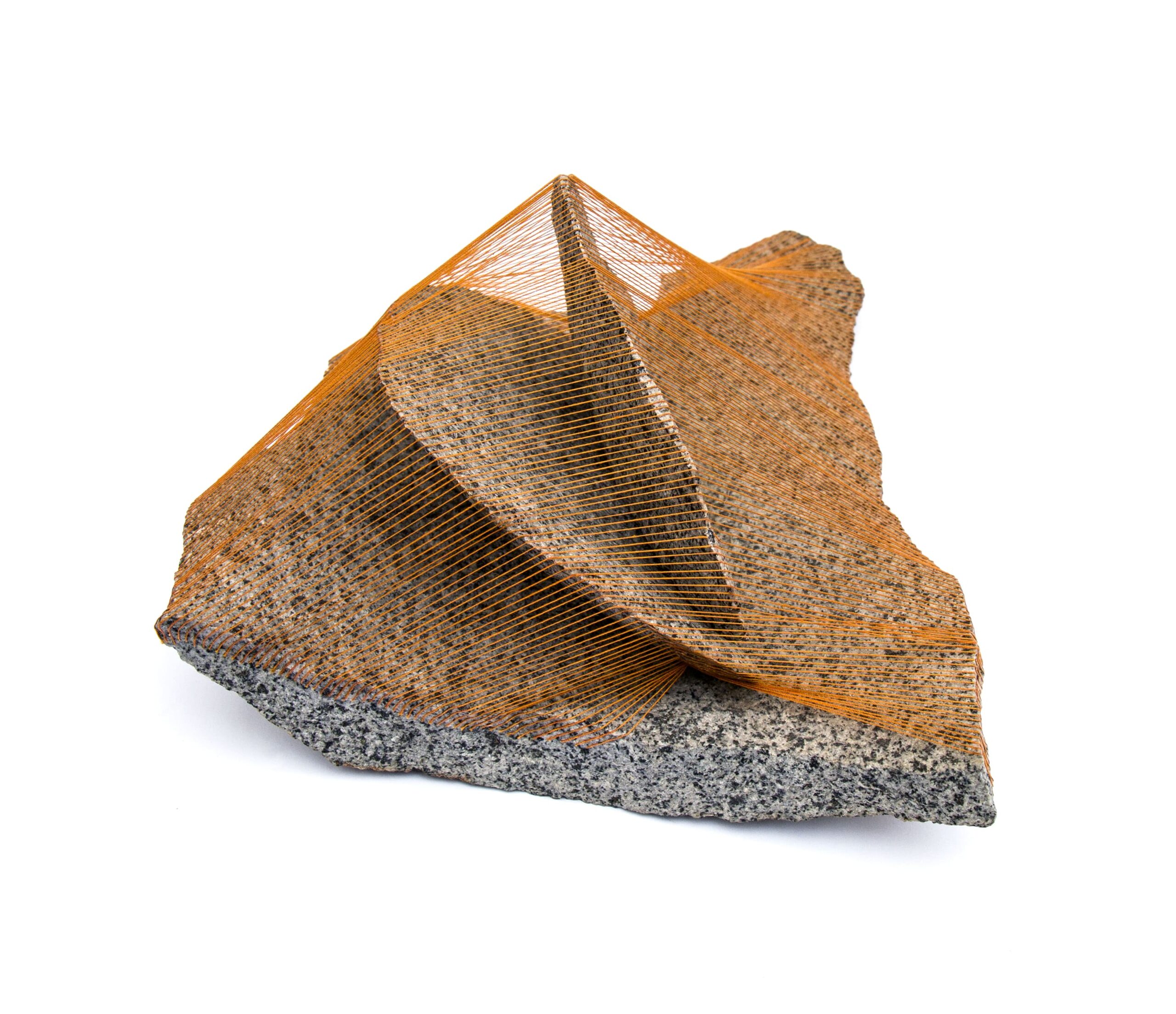
You work a lot on the geology and transformation of matter. Where does this interest come from? My practice develops around a central axis: the environmental transformations generated by human actions, such as the extractivism (e.g. mining activity); the changes proper to planetary dynamics in natural environments; and the natural processes that allow the formation of rocks.
**And time is the other great theme across your search. No, you are not wrong: time and especially geological time is one of the most recurring themes in my work: to reflect on the connections of matter and on the transformations that go through ecosystems is in fact a central objective of my research, guided by questions about natural events that lead to the formation of the three large groups of rocks on the planet: fiery, sedimentary and metamorphic. I am attracted by this time scale because the appearance of humanity occupies a minimal portion of earthly history: for this reason I believe we will never be witnesses of all the evolutionary processes that the Earth will pass through. It is precisely this uncertainty
You have also introduced an important concept: that of anthropic rocks. What do you mean? Today it is possible to identify a fourth group of rocks, called 'anthropic rocks'.This new classification includes urban structures created with concrete: a mixture composed of concrete, sand and stones. This is a material associated with progress and modernity, but also with the emission of high concentrations of carbon dioxide in the atmosphere, contributing to global warming and important climatic changes. In this sense, my sculptural proposal suggests that in the future, the material created by humanity can merge with natural rocks, giving rise to new types of matter.
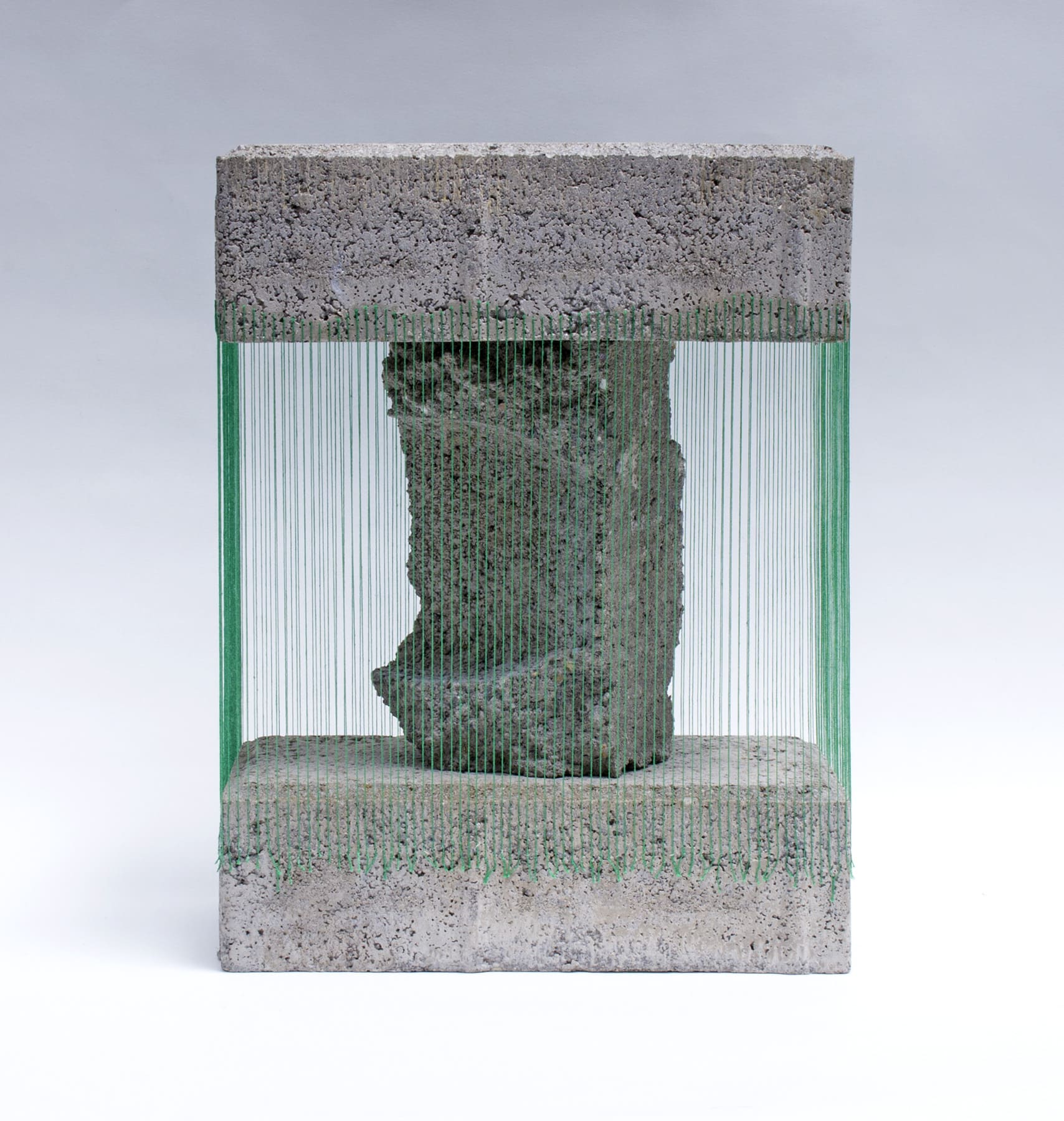
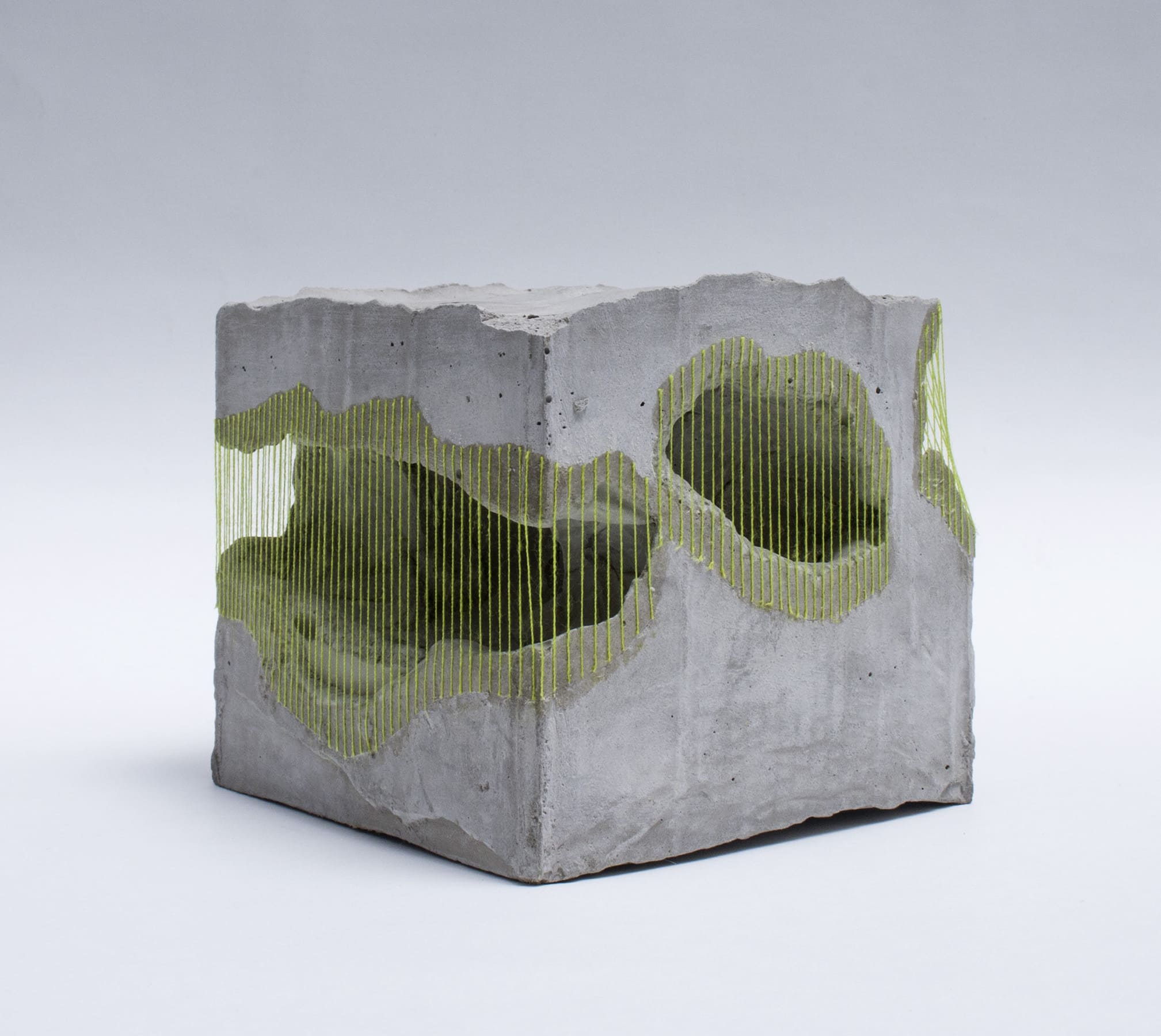
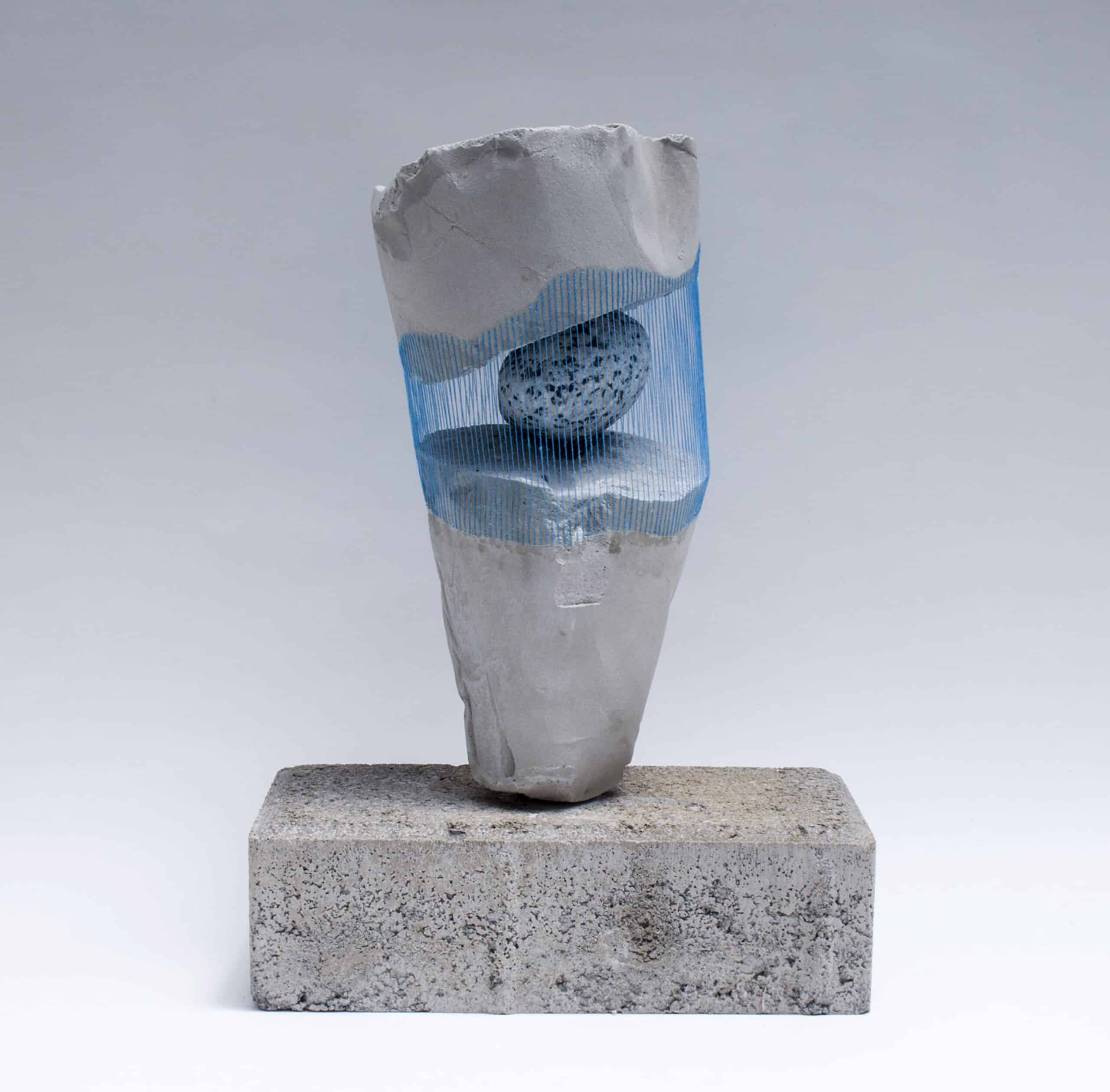
So you're imagining a kind of 'third matter', neither natural nor artificial? Yes, you've explained my idea perfectly. My intention is to anticipate the new forms of matter that can be created after the passage of very long periods of time. In this case, the wires represent the natural forces that will melt the natural and the anthropic matter, giving rise to this third form of matter or to new types of rocks.
Does your work follow a single central idea over time or each cycle arise from different questions? Up to now, the central idea of my work is represented by the environmental transformations that the planet crosses, both in a natural and anthropic way. The evolution of my projects requires periods of pause, rest, observation of natural environments and reading of scientific articles. From there I begin to connect new concepts, experimenting with other materials and other forms.
And yet, at some point, photography was no longer enough. What was the 'trigger' of the passage to matter? My work consists of a set of photographs of landscapes and natural elements of Chile. These images are grouped according to the type of material intervention. A first group corresponds to photographs which were analogically taken with layers of the same image, working with repeated prints of the same photograph. A second set is made up of volumes created with the same photographs, through the pop-up technique. A third group includes interventions that use images from Other photographs of mineral textures, with a process similar to collage. As my creative process advances, I feel that photography and matter connect, both conceptually and through physical intervention.
And yet, at some point you left photography as the main medium. What was the 'trigger' of this passage to matter? After all I never abandoned it, it simply remained the starting point. This process took place during the mentorship DARDO. The artists who guided my path suggested that I stop using photography as an expressive source. In other words, I was encouraged to stop using photographic materials, techniques and photographic mediums. At that point, having a large number of rocks in my house, I started to intervene on them and discover their possibilities as artistic objects.
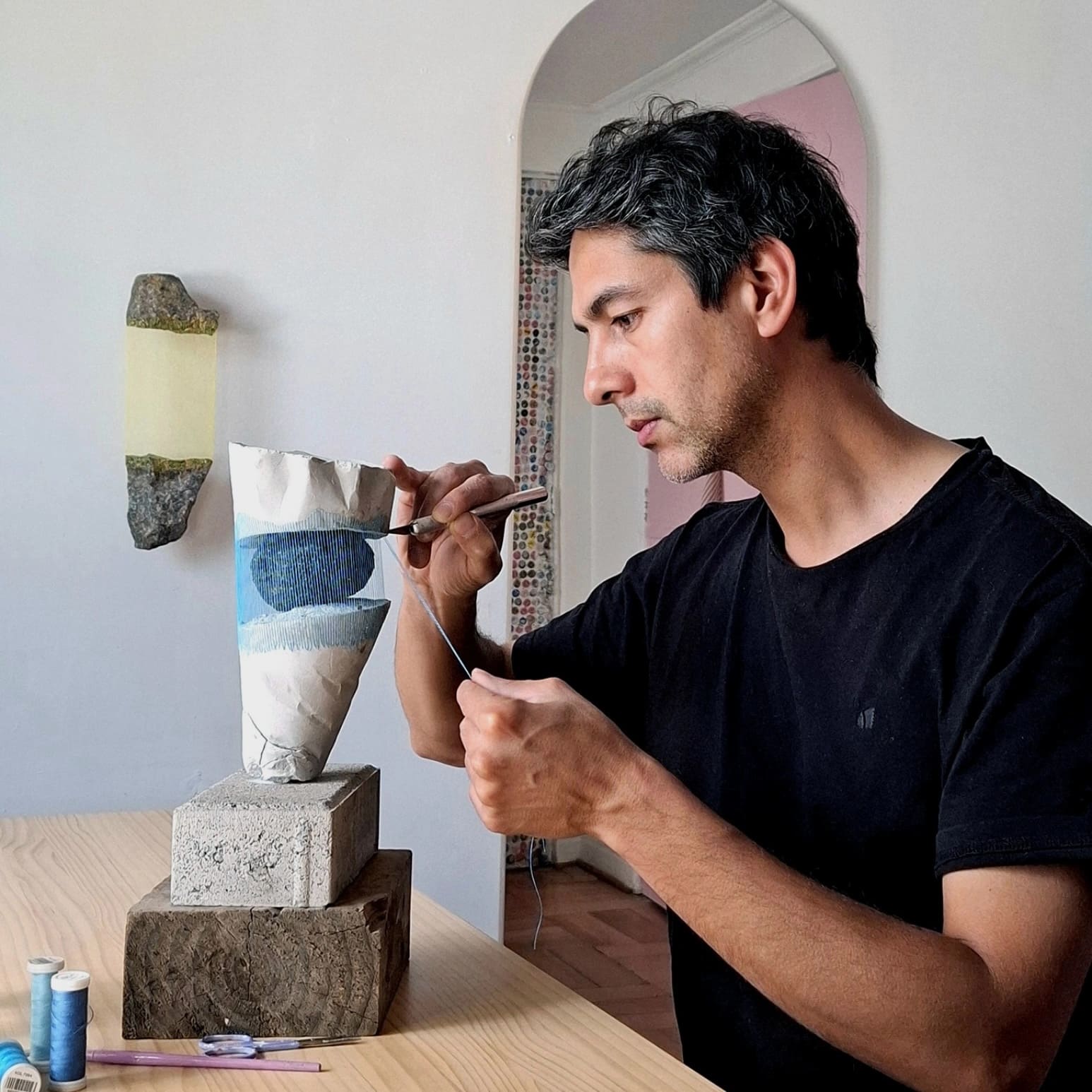
How did you learn to work with stone? Was it a technical or intuitive process? At the beginning it was above all an intuitive process: I began to intervene on very different rocks, trying materials and possibilities. At a certain point, observing them for a long time, I realized that some stones had cavities and fractures that, in a phase of their history, had been filled with natural materials. From there the idea was born: to resume that geological gesture and continue it in a symbolic way. I began to fill those voids with sewing thread, as if I could reactivate an internal memory of the rock. Later, the work expanded: I began to build objects with plaster and cement.
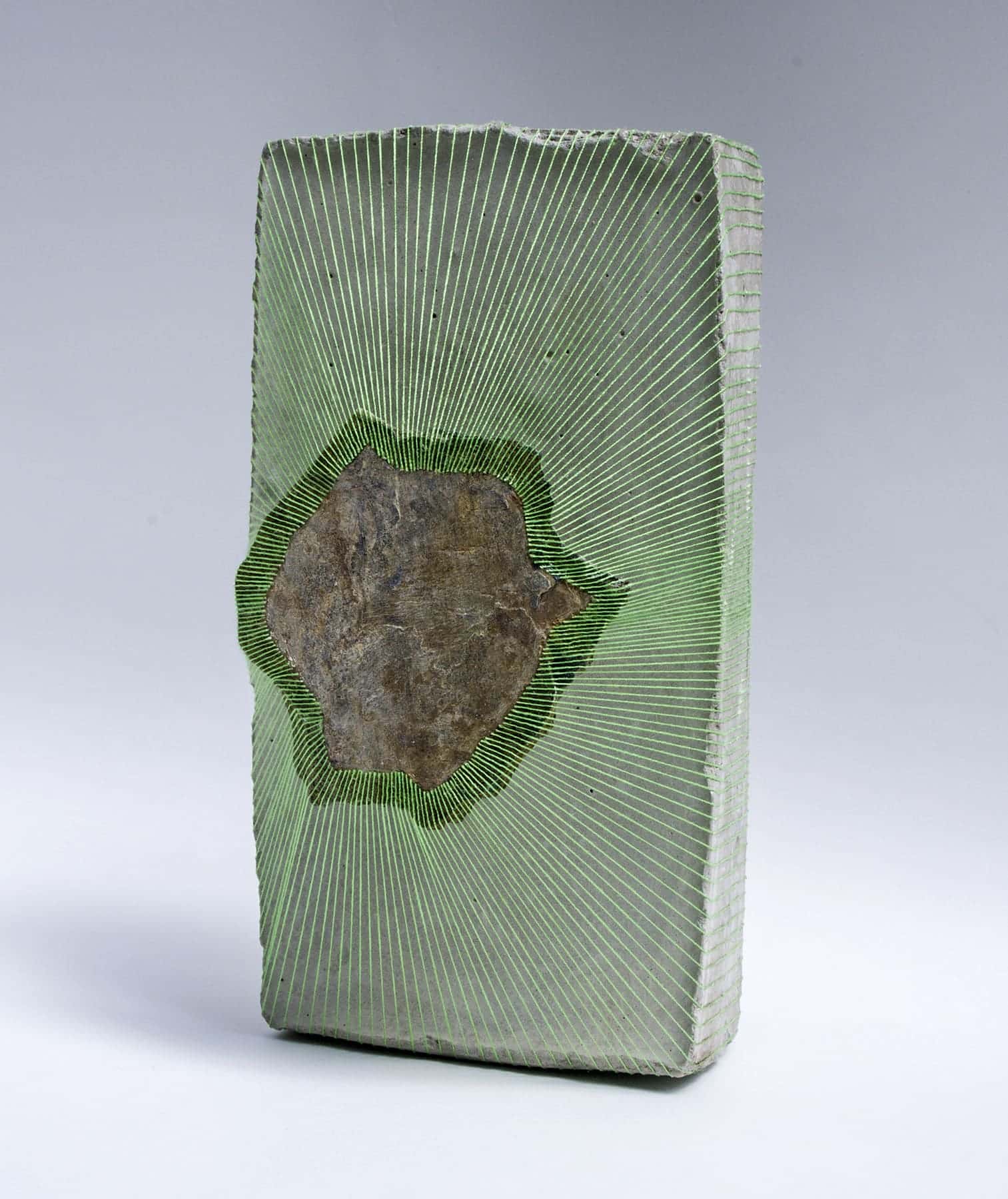
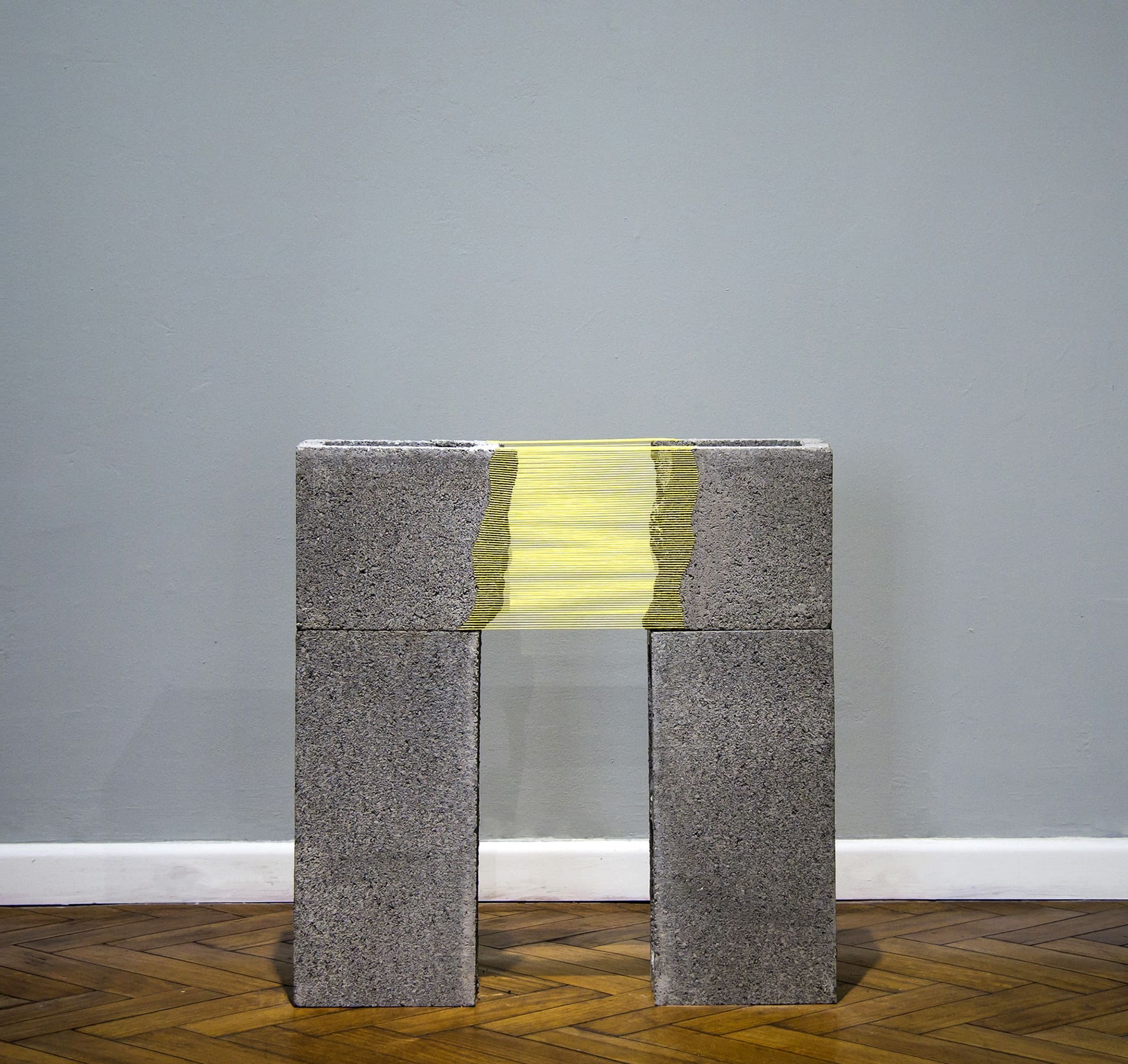
How did this more material research develop after photography? During the period of experimentation and creation of the works of the exhibition, my attention focused on metamorphism: a natural process in which rocks, subjected to high pressures and temperatures in the earth's crust, transform and compact until they merge into solid state, without getting to melt really. From here a series of questions about the geological future of cities were opened: what will happen to urban structures? How long will a mineral memory remain in them? And to what extent does man build concrete, concrete, fragments of infrastructure The thread is used to fill and connect spaces, voids and fractures: it is a sort of pre-anticipating reconstruction of what is no longer there
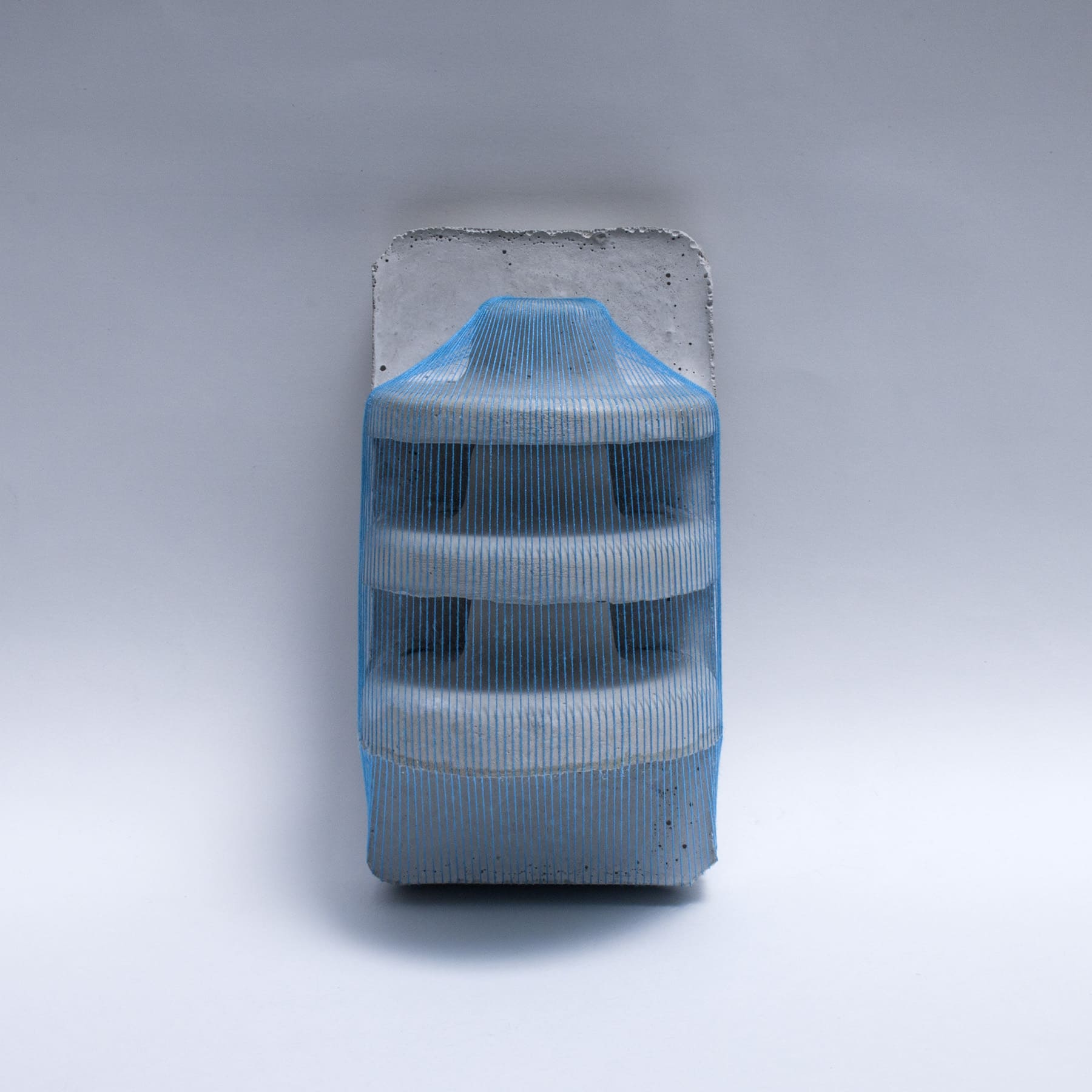
What does it mean to sew stones?** The 'sewn' stones, for me, is a gesture of connection: the wires that combine materials of similar or dissimilar origin become an interface between the anthropic and the natural and, in a poetic and metaphorical key, make visible the bonds of the matter of the planet. Thus the works become containers of overlappings, volumes, voids, reliefs and textures crossed by different temporalities: a way to rethink how planetary dynamics transform matter and how the human tries to understand transformation as a force that makes the passage of time perceptible.
This perspective also opens up a philosophical dimension: Do you recognize yourself in the thought of the Anthropocene and the post-human, for example in authors like Donna Haraway? Yes, I recognize myself very much in this dimension. The Anthropocene and the post-human, for me, are not abstract theoretical categories: they are a material reality that you see and touch. I am interested in that point where what man builds  concrete, concrete, infrastructure   stops being only   human and begins to become geology. In my work I try to imagine a time when human and natural matter will no longer be distinguishable, but will enter into a same transformation, generating hybrid forms. It is a way to think matter not only as a trace of human presence, but as something that can survive man, incorporate it and continue to change, independently of us. After all, it is also what interests me: to shift my gaze from the human to the material, as if the Earth had its own memory and an autonomous force of transformation.
The interview with Emilio Fuentes Traverso marks a new stage of L'ARTE IN PRIMA PERSONA, a project promoted by Cramum together with Schiavi SpA, with the ideation, concept and creative direction of Sabino Maria Frassà. Discover the previous episodes:
Liu Chien-Kuang. Glass, art and memory
To view videos, enable external content in your cookie preferences.