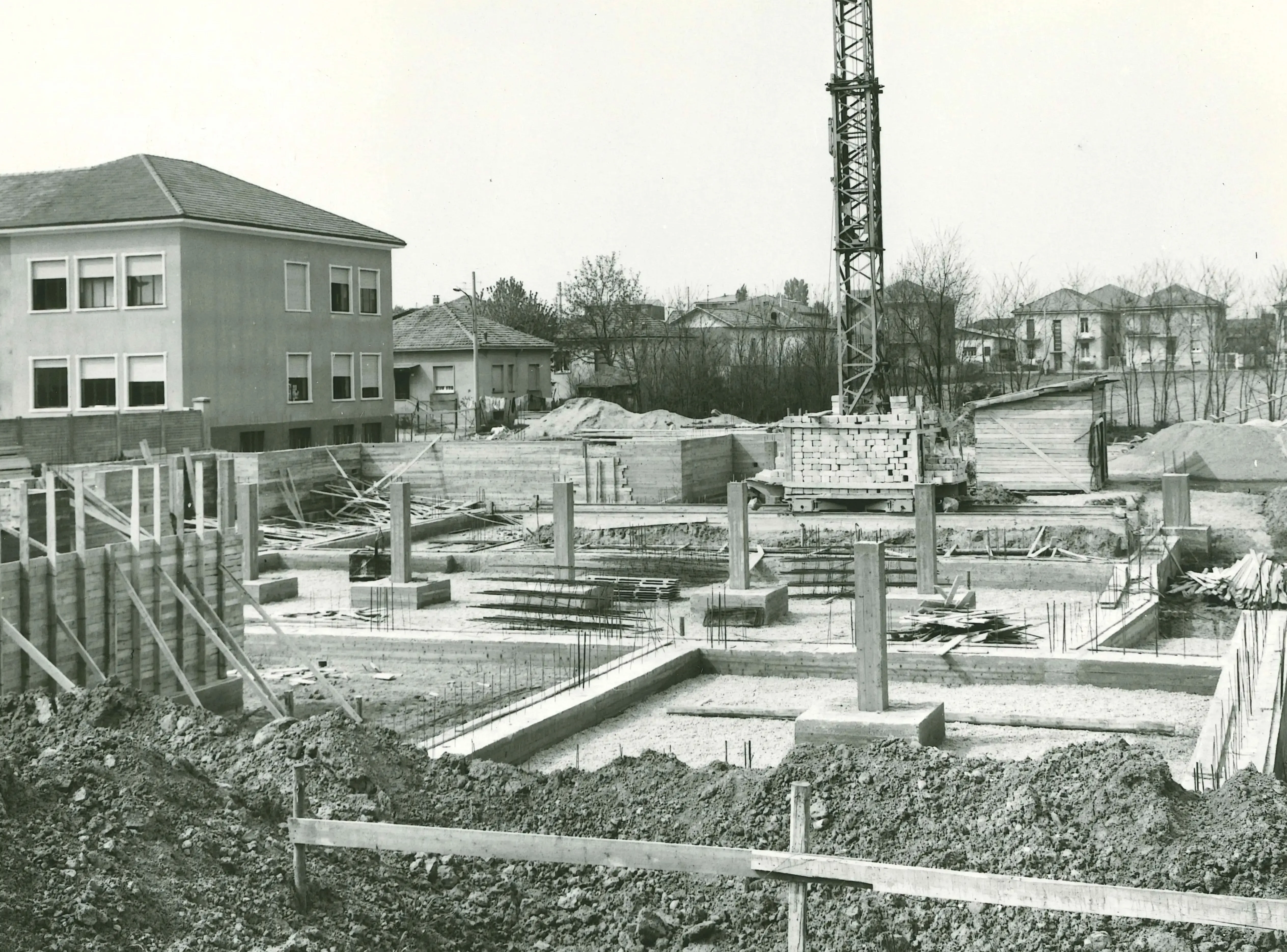
After 1817, in the Germanedo quarter of Lecchese** stood a silk and water threadhouse with adjoining residence** belonging to the ** Pecoroni family** which, at that time, began its economic rise. In particular, it is with Pietro Pecoroni, son of a Leccosian owner and dealer, that the previous owner of the vast particle on which the spinning machine will be built, Marco Invernizzi, establishes an agreement that includes the vitality on some surviving property. It is worth noting that according to the notary act dated January 1817, the understanding involves different funds in Germanedo: a wood called Selva, land called Badello and above all a growing with vines called Pomarolo, a wall-walled lime with civil house and by massaro called the Palace with wine press.
It is right on the edge of the Pomarolo estate** that the Pecoroni family will build the homonymous spinning mill, next to the Palace which, for the agreement entered into, remains half in enjoyment to the previous owners**, natural life during. Pecoroni also corresponds a vitality to the winters, in whose availability some rooms of the residence remain: • On the ground floor, a kitchen and another large room for use of pantry and small room where is the fountain (for common use with the Pecoroni from the porch); on the first floor all the upper ones up to the roof above the said ground floor, that is, starting from the large room and following rooms that remain at the straight on the staircase going up under the porch. All the remaining of the Detà house Civile and for use as a massarizio will remain Mr. Pecoroni*"AsCo" (Acts of the Notaries, 5668). Ultimately, the contract of sale Winters/Pecoroni is the turning point for a significant economic understanding, which in 1818 translates into the further ** purchase**, by Pecoroni, of nine maps to Germanedo, for a total that reaches a well sixty pertices. It is easy to understand that Pecoroni had the economic availability** to carry out this kind of business but, on the other hand, the whole family had enjoyed a long time of prestige and stability**: his father Francesco Maria Pecoroni, a shopkeeper, had in fact enthusiastically joined the Cisalpine government, and had also obtained from it the charge of Inspector of Finance in Varese, resulting in the annual allowance.
The sons of Francesco Maria follow a similar path, in terms of political sympathies: the firstbornBartolomew voluntary part as a petty officer in the 1st regiment of the Ussari, the brother Joseph asks for exemption from military service, while Peter is contracted by the Congress of the Eximus of Lecco resupply of food and forage to the French and Italian troops, both in transit and stationed. Pietro thus obtains rice, salt, meat, wine, bread, wood and fodder for more than twenty-two thousand lire**, of which he finally manages to obtain the balance after laborious bureaucratic traverses. His wife, Maria Arrigoni**, is careful and well-thought-out to deal with the management of the heritage and, in 1800, Peter is rewarded for his republican fidelity by obtaining the capitals to start a different cotton factory, which takes momentum after the Restoration.
Thanks to the economic robustness** necessary to give life to its ambitious enterprise, with the support of the winters the ** Pecoroni family** kicks off a project that will change the Germanedo district forever. Sources and Bibliography. State Archives of Bergamo (AsBg), Atti dei notai, 12122. Archivio di Stato di Como (AsCo): Atti dei notai, 5668; Camera di Commercio, 144, Notifiche exercisei del Circondario di Lecco; Catasto, Germanedo, Libri partatori; UTE, Germanedo, Volture. Archivio di Stato di Milano (AscMi): Atti dei notai, Ultimi paggi, 318; Catasto Teresiano, Lecco, mappa preparatorye. Archivio Storico Civico di Milano (AscMi), Families, 1135. F. D'Alessio, Transhumanze real estate: Stoppani e Pecoroni tra bottega, palazzi e cererie, in Archivi di Lecco, I, 2017, pp. 118-121; A. Garlandini, M. Negri (edited by), I monumenti storico-industriali della Lombardia: censo regionale, Milano 1984, pp. 243-244. We thank in particular the historian Cristian Bonomi, Barbara Cattaneo (Direttrice scientifica del Sistema Museale Urbano Lecchese della Si.M.U.L) and l'ing. Francesco D 'Alessio.
To view videos, enable external content in your cookie preferences.