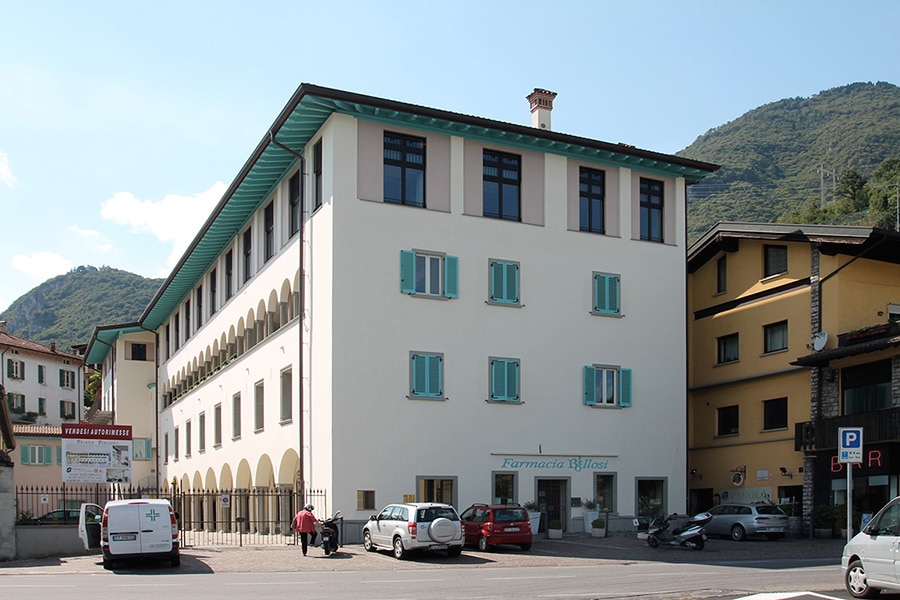
For some months now we have been facing an interesting journey in the redevelopment of Palazzo Ferlendis, in Lovere**. After exploring the history and function of the building over the centuries, we are sharing with you a more practical and current aspect**, linked to the profession and the world of constructions that, in the common imagination, is often misunderstood and misunderstood: the one related to design. In the common culture the role of the designer is all too often misunderstood. His professional activity is perceived as limited to purely aesthetic issues, linked to the stylistic choice of colors and materials. It was almost a simple embellishment activity, the design meant in this way inevitably relegates the designer to the role of mere decorator. Nothing more ** far from reality**! A test is represented just from the redevelopment work carried out by Schiavi Spa for Palazzo Ferlendis. Designing a ** recovery intervention on a historical asset**, in fact, is a complicated process that does not involve so much a 'embellishment' of the building, but rather deep competences in terms of historical, architectural, economic, technical. Not only: the design phase also involves different professional figures giving rise to a real ** teamwork**. design of a recovery intervention on a historical asset requires first of all accurate assessments in terms of economic: building is not enough, if it is not perfectly clear what needs to be built. In practice, this translates into a precise planning capacity of real estate activity, as well as in an accurate analysis of the market to understand which housing offer is most appropriate in the land of reference, avoiding the risk of building what already exists. The economic analysis is, in fact, the premise of architectural design: it is essential to have clear objectives to achieve and the number of housing to be built to reorganise in the most functional way available spaces, while ensuring the best quality standards for all accommodation. The precision is an essential plus when working within an existing historical asset, as is Palazzo Ferlendis. Once planned the intervention and arranged the spaces to be realized, it is the time of the detailed study of the putting into action. In this sense, what is indispensable are technical skills and a great knowledge of materials, so as to choose, on a case by case basis, the best realization techniques. And if, as in this case, we are working on an historical asset, it is essential also a historical analysis of those of the past: only in this way will it be possible to study solutions capable of harmonically reporting with the existing structures. Here is that the designer is to interact with other professional figures, so that the entire team of work offers its contribution not only in the design phase, but also in the realization. The designer, far from being a simple decorator, is on the contrary charged with coordinating a heterogeneous team and putting in place spicced management skills.
There is one last point worth addressing when it comes to the importance of the design of a building: the one relating to the historical value of the building on which it operates**. In a context like that of Lovere, Palazzo Ferlendis represented and represents the testimony of a past that is history and culture of the place, territory and population. Do not distort the identity of the building is therefore indispensable, and the planning of the recovery intervention must on the contrary ** valorize it** with a project capable of recovering and updating in a harmonious and synergistic way the entire structure.
It is with these principles in mind that we at Schiavi Spa have faced the work of redevelopment of Palazzo Ferlendis. The result, choral, is highlighted in every detail of this ancient palace finally returned to its original splendore.
To view videos, enable external content in your cookie preferences.