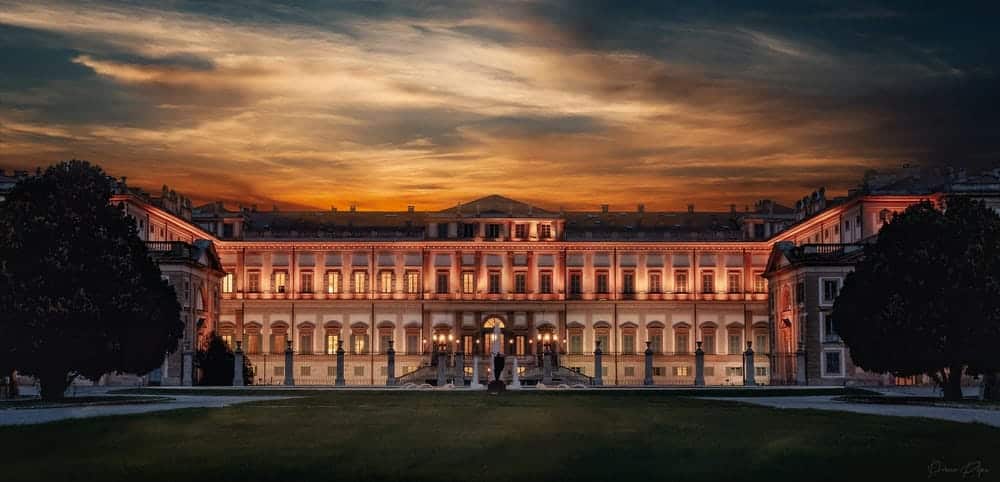
The Monza Royal Palace**
The villa still retains its name as aristocratic** because, for a long time, it was inhabited exclusively by rulers: by the governor general of the Austrian Lombardy Ferdinando d'Hapsburg-Este (whose mother, the Empress Maria Teresa d'Hapsburg, had personally requested the building of the palace) to the Viceroy of the Kingdom of Napoleonic Italy Eugenius of Beuharnais (who commissioned his trusted architect Luigi Canonica to build the court theatre) to the Austrian Viceroy *Ranieri Giuseppe Hapsburg-Lorraine, elected during the new Kingdom of Lombardy-Veneto.
And it is mainly to this last figure that the luxurious botanical wealth that still characterizes the great park and gardens surrounding the villa. Currently, the extensive green spaces around the neoclassical palace have become a meeting place for the community Monzese and the neighboring provinces, an environment of incredible charm in which relax but also a location for the organization of exclusive events. At the same time, the park and the gardens continue to stand out as natural universe of extraordinary variety and craftsmanship, which houses in its own interior different "ambients" very rich of botanical species. An example is the so-called Orangerie, that is the structure once destined to greenhouses that the Monzese know by the name of Â"Serron" . The building is located ** on the north side of the Royal Villa** and has remarkable dimensions, enhanced by the presence of the huge windows. Inside the Orangery were originally guarded (in the winter months) the most delicate plants • in particular those exotic • and, although today these spaces are used for ** artistic exhibitions**, near the structure was planted a large rose garden to celebrate the origins of the construction. To confirm this imprint still unchanged, the Serrone is the permanent venue of the annual floral contest organized by the ** Association** ** Italian Rose**.
However, the nature of the Monza Palace** does not stop here: the park is in fact so wide and articulated that it has transformed, over the centuries, into the perfect place for the luxuriant growth of countless botanical species, as well as the presence of precious local fauna.
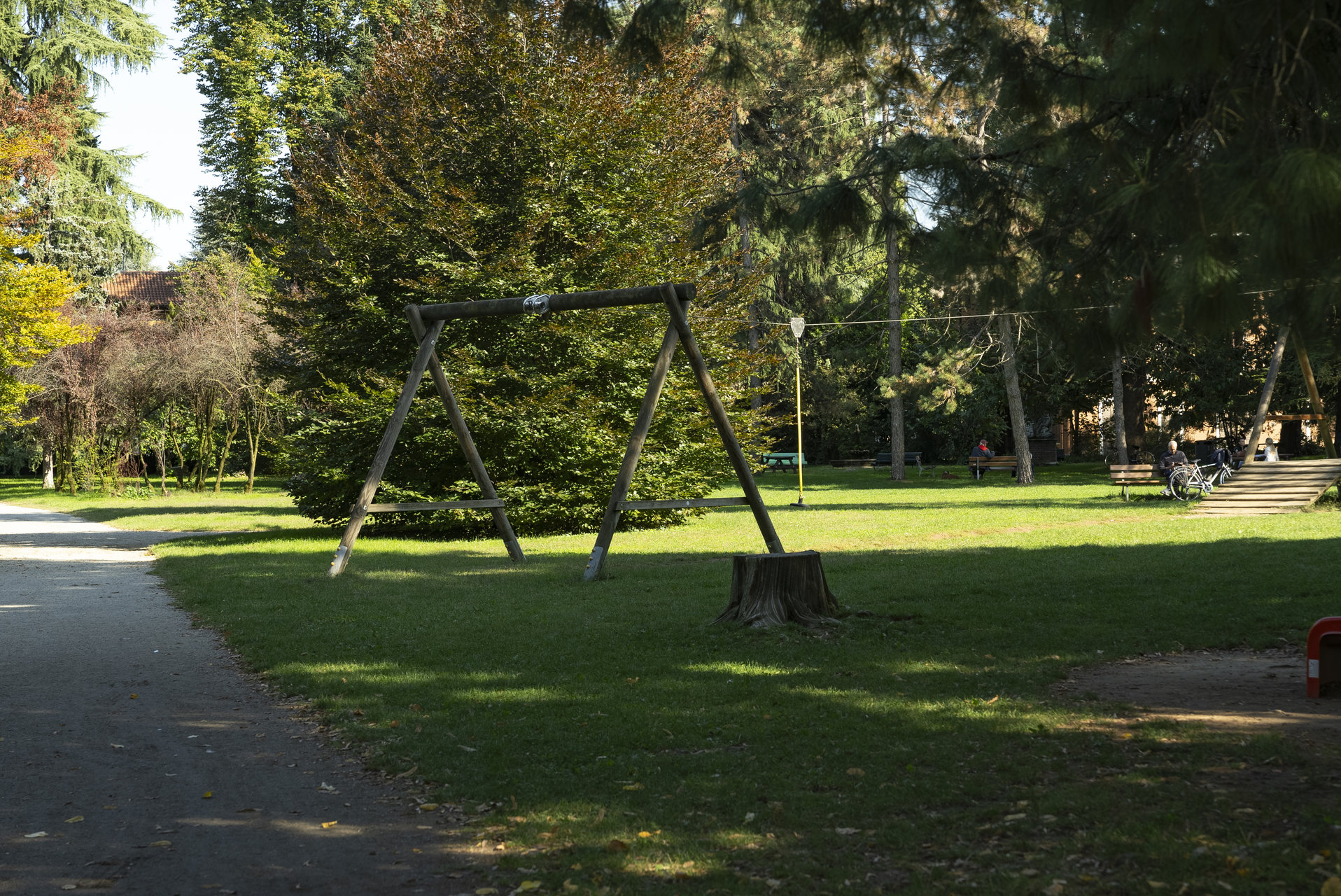
The Gardens and the Park of the Royal Villa: hundreds of hectares of pure nature The vastness of the gardens of the Monza Palace is undoubtedly extraordinary: we are talking about an area equal to about forty hectares (or 400 thousand square meters!) that surrounds on each side all the buildings of the complex. Royal Park, instead, is divided by the gardens by a fence and extends even for six hundred hectares.
In the Napoleonic era and at Bonaparte's own will, the entire space in the outside had been structured as a model farm** but also as a private hunting reserve** and, for this reason, it hosted (and still hosts) the so-called green giants**": ultra-secular trees planted to enrich and inflate the tree heritage of the area**.
The variety
Not far from the well-known Ginkgo biloba Monza There are also numerous other botanical species: from hippocastani to farnie, from sofor to bees, from platani to liriodendri. A complete map of the green giants* **" of the Royal Villa is available a this link.
Bear garlic: •Smell of the park of Monza Who attends the Park of Monza is certainly aware of the typical •Smell of the park that emanates up to outside its fence. It is a rather pungent but not unpleasant ** smell, decidedly vegetable, which reminds , although less intense , that of the classic garlic that we use in our kitchens.
It is the bear garlic (Allium Ursinum), a perennial plant that, starting from a bulb, produces lanceolate leaves with white flowers easily recognizable. This is why the park of the villa is dotted with white from May onwards**, especially in the rich area of the undergrowth.
The bear garlic was introduced to the estate during the Austrian period** to keep away harmful insects and, still today, it represents one of the multisensory experiences most typically associated with this Monzese public space.
Water: the heart of the Park and the Gardens of the Palace of Monza Water plays an absolutely crucial role in the life of the park and gardens** surrounding the Royal Villa**. In fact, it is almost certainly to it that one owes at least in part the formidable and lasting natural wealth of the estate.
The well-known river Lambro**, which originates in the heart of the Lariano Triangle**, just above the Ghisallo**, runs through the outside of the Monzese Palace, and runs practically through the All Brianza Before joining the Po. In its long "passeggiata" in the province, Lambro touches and nourishes also the Park of Monza for about three and a half kilometers, and this is the reason why inside it there are still today small bridges and closed.
The complex water system that feeds the park and the gardens of the villa is directly connected to the river, around which you can admire large wooded areas filled with plane trees, in some cases also monumental, pioppi, black alders, larger ashes, lindens and white willows. A natural spectacle of undeniable beauty, especially wonderful during the autumn months. The estate also houses four roges, whose tracks continue to be well recognizable: the Roggia Molinara, the Pelucca, the Dry Mills and the Prince.
They were not even the only ones once present in the park:the Gallarana, Ghiringella and the Friars were also part of the original territory, but they have unfortunately disappeared today. What were these small and pretty watercourses used for? For the most diverse activities: to water** the fields and farms (even working in a cadence and alternating way), to feed** the mills and laundries, to drain** the waste water or even to send** the water to the gardens of the villa. This is the case of the Prince's Roggia**, which forms the Laghetto, the Waterfall and the small water mirror near the Belvedere**, and then exits the Gardens and turns into the Sighs Valley Lake** before finally joining the Pelucca's Roggia**.
And it is right around these water streams, and especially the latter, that the many animal species in the park find their home.
The fauna of the Monza Park The animals who live in the gardens and park of the Monzese Reggia tend, understandably, to be screw and not to want contact with the human being. For this reason, their fixed presence in the estate could be even a surprise for someone.
In truth, the park is still usually frequented by various species of birds, such as the red woodpecker, the brickpecker, the Mandarin duck and even the splendid civet. L'usignolo, once present in the area, #It seems to have disappeared #due to the increase of the anthropic disorder, while the presence, at least until some time ago, of some cinciallegre, of herons cinerine, crags, pheasants, allocchi and even of some martin fisherman has been reported. As for the ** amphibious species**, the estate houses the Rana di Lataste It lives almost always in the undergrowth and moves in water only to reproduce. Its presence in the area is not obvious, especially if one considers that the frogs of Lataste that live in the park are ** among the last present in the entire province of Milan.** Finally, mention of honour for the timidissima red fox, almost the ... ghost of the estate but in reality present in few, very precious. When seen in daylight very rarely, this twilight and night animal** feeds mainly on rodents but also on fruits and berries, and plays an important role as a natural sweeper** for the entire park.
To view videos, enable external content in your cookie preferences.