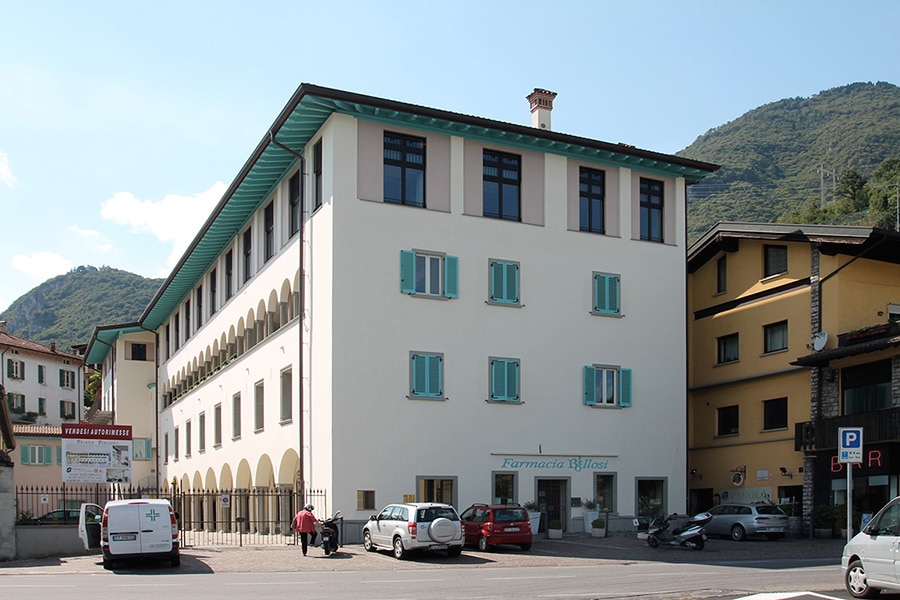
** Palazzo Ferlendis** is the building that embodies the historical soul of Lovere, one of the most spectacular villages of Lombardy and Italy. A long past, made of constant refinings, modifications, changes of destination of use, is the basis of the history of the building that, with its imposing size, overlooks the lake as a silent guardian. Schiavi Spa intervened on the Palace for a complete restoration work that has concerned almost every aspect of the building. The ultimate goal, as is normal in these cases, was to bring the building back to its ancient splendor** in compliance with its historical and stylistic identity, and the intervention was therefore preceded by an accurate study of the The building, by the family Ferlendis, is to be located between the end of 1400 and the beginning of 1500. The palace was, at the time, located directly on the shore of the lake, in compliance with what was at the time the town topography, then changed over the years. Just in front of the newly born Palazzo Ferlendis, at the beginning of the sixteenth century, there was instead a mulattiera which at the time represented the main access to the Valcamonica.
The Ferlendis family** was particularly well known in the territory for its production of scarlet cloth, whose industry was flourishing in the Lovere area. It is assumed that the activity was carried out in the warehouses adjacent to the Palace, which was nothing else but the family building. This type of approach is not accidental: at a time when trade took place mainly by lake, the Ferlendis lived and worked a short distance from the shores of the lake.
In the eighteenth century**, although not changing its structure, the building was split into several properties**, transforming into a sort of microcosm within the village of Lovere, with its appliances and houses for rent to divide map and particles: the subsequent unification of the building will take place when the property of some lots takes over the Abbot Domenico Puccinelli, Prefect of the Ginnasio Comunale.
For the first half of the 19th century, the Ferlendis Palace** will remain a residence with tavern, stable on the ground floor and warehouses, and then be donated to the ** Municipality of Lovere** in 1853 by Puccinelli himself.
A change of the building particularly noteworthy occurred at the beginning of the nineteenth century**: from 1912, in fact, Palazzo Ferlendis housed the factory of ** Sebino bikes** and, subsequently, the assembly chain of the A.C. cars, for a total production of seventy specimens, of which thirty were sold to the Italian Royal Army. This important manufacturing activity was, in a sense, prelude to the excellence of the Emilian automobile that is still famous all over the world: Antonio Adani, one of the two representatives of the Swiss motorcycle brand Moto-Rêve and owner of the activity, was in fact originally from Modena. It is located at this historic moment the last moment of fervent activity of the Palace in modern times, before its ** aesthetic and structural decay** on which Schiavi Spa intervened with a work of rational and detailed conservation restoration, of which we are particularly proud.
To view videos, enable external content in your cookie preferences.