When you think of the balcony applied to the arts • literature, theatre, cinema • it is very likely that the first to come to mind is that of Julietta Capulets. In fact, it is his balcony that is the most famous in the world**.
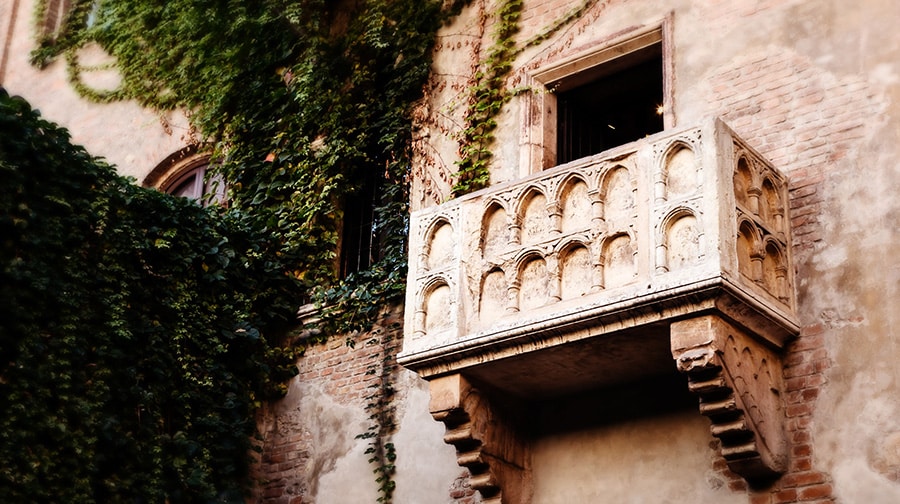
The balcony of Juliet is obviously housed at Verona and is one of the main attractions of the city: it faces a small inner courtyard daily filled with thousands of tourists from every corner of the planet, a snake that crosses the street through the close arched gate, with the walls covered with declarations of love written in a marker. Visitors stand up to look at the balcony from which Juliet would look to see her Romeo, in the homonymous work of Shakespeare.
It is not incredible to think that the most famous balcony in the world is dedicated to the character of a literary work, to someone who never existed and whose author never, however, even visited the Venetian city? Despite everything, Verona is and will always be linked to the fate of his two unfortunate lovers, and all the "se" and "ma" surrounding them remain in some way subtleties of little account.
Let's take a look at the house and the balcony of Juliet** from a purely architectural and historical point of view. It is essentially a medieval palace** that rises a short distance from the central Piazza delle Erbe. This structure is the focal centre of a real connub between reality and legend: if on the one hand the Capulet never seem to have existed, instead the presence in Verona, during the Dantesco period, of a certain family Cappelletti (note the assonance between the names!), which probably resided in the actual house of Juliet** , as evidenced by the coat of arms of the hat on the keystone of the entrance arch to the courtyard.
The house of Juliet today and its famous balcony, whose origins are uncertain and however before the fourteenth century, are in fact the result of a fantasious remodeling occurred just before the mid-Twentieth century and aimed at giving life to the perfect medieval scenery for the Shakespearean drama of Romeo and Juliet. The balcony stands out in the front, from the brick facade with a light appearance embellished by trilobed windows of a certain elegance. The entire building is an example, in truth rather valuable, of Roman insula structured in court through the subdivision of the Gothic lot, with free spaces inside and passages porticoed towards the street. The house wants to represent a realistic reconstruction of the typical** Venetian noble houses of the fourteenth century**: it is the result of the very complex restoration, which considered first of all essential the structuring of the spaces and their consistency with the medieval ones.
The House of Juliet** is also known as the House of Dal Cappello**, in reference to the spice merchants who settled here, first with two adjacent medieval towers and then with a later construction. As for the restauration of the famous balcony**, it is to be attributed to Antonio Avena, Italian historian, director of the Verona civic museum in the first half of the twentieth century and supporter of the protection of the artistic and architectural heritage of the city of Verona.
It is interesting to find that the original aspect of the structure is, today, almost totally immersed in the mystery and that, before the twentieth century intervention, the balcony of Juliet was practically nonexistent. But at the bottom what does it matter? The balconies, these architectural openings to the world, are not themselves also a gateway to imagination? ** Let's keep imagining!** ** Julietta: oh! How did you enter here? And to what end? The walls surrounding this garden are arduous, and almost inaccessible; and the place where you stand will be tomb, if any of my people surprise you. * *Romeo: "Coll"ali dell'Amore valicai l'height of those walls, why barrier does not vÂ"ha to the mighty Love: all that Amor can tempt, Amor lÂÂ Â Â Â Â Â Â Â Â Â Â Â Â Â Â Â Â Â Â Â Â Â Â Â Â Â Â Â Â Â Â Â Â Â Â Â Â Â Â Â Â Â Â Â Â Â Â Â Â Â Â Â Â Â Â Â Â Â Â Â Â Â Â Â Â Â Â Â Â Â Â Â Â Â Â Â Â Â Â Â Â Â Â
To view videos, enable external content in your cookie preferences.