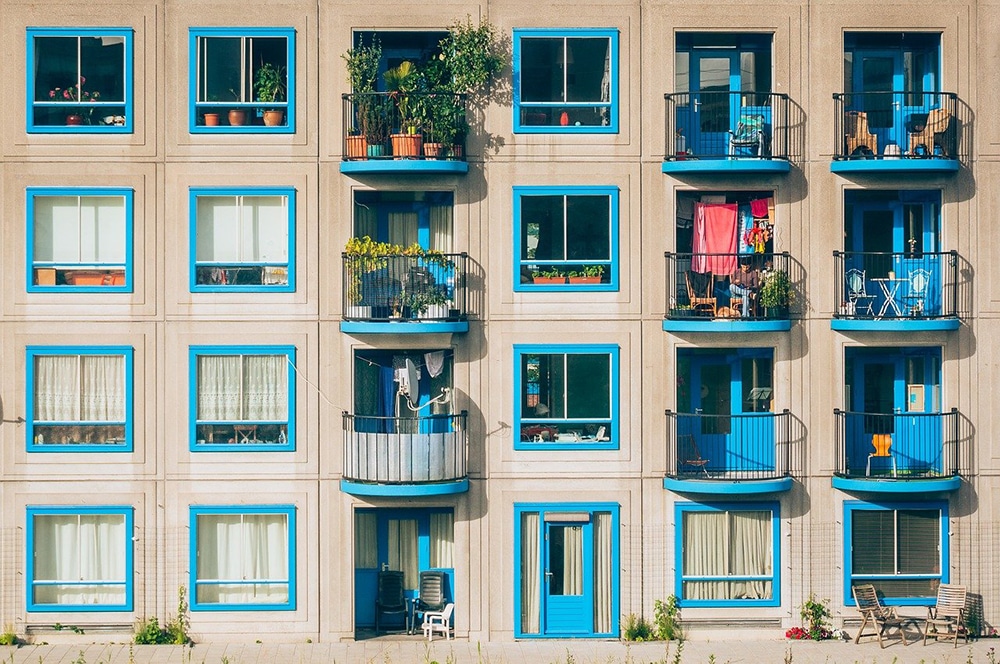
According to the famous Italian Encyclopedia Treccani**, the balcony is the architectural term that identifies a kind of window open to the floor and equipped with railing railing railing, perforated or balaustrato. The balconies have mainly a ** decorative function**, but it is undeniable also their ** practical utility** › more than ever highlighted by the transformations of balconies and terraces in more recent times: ** ecological oases, places of relaxation, solarium** or, more simply, overlooking the surrounding world and ideal prosecutions of the family atmosphere and intimate of the house.
To trace the birth of terraces and balconies** we must make a long journey that takes us to the Far East: Persia and Egypt, respectively with the palace of Xerse in Persepoli and with that of Ramesses III in Medinet Habu. In this last case in particular, the balcony Moving towards the West and going to the Old Greece**, we will discover that the balconies were already built in private houses, that their construction was governed by specific rules and their presence even taxed. Balconies were also loved by the Etruscans**, and less could be the Romans**. In the Old Rome**, it seems that the construction of the first balcony is to be attributed to such G. Menio, censor in 318 BC.
He erected what was called a
At the beginning of the imperial age the status of the balcony in Rome was now 'cosa', so much to be documented even in Pompeian painting. Mostly it was housed with windows, suspended on shelves and masonry arches and limited adjecting from the front. Let's now leap forward of some centuries and rediscover the origins of Venetian architecture. We know how many characters like Palladio and Vincenzo Scamozzi played a central role not only in the architecture of a geographical area but in most of the European monumental building from the seventeenth century onward. Let's stop, however at the beginning of 1500 and let's limit ourselves to the ** Venetian context** par excellence: we will discover that to build a large number of balconies that lean on frames and mesolets, usually without protruding much, was common practice. Some of the medieval balconies** were erected on frames at one or more of the mesoletto's resorts, even in this case with little emphasis. Let's now move south and we arrive in the area of Viterbo**, in the current Upper Lazio: and here again the balcony, known as profferlio and characterized by an external staircase. An example of this particular way of realization is still visible today at the Palazzo del Capitano di Orvieto.
During the Renaissance, the balconies became pure artwork   not only functional but also aesthetic   as is still visible at Pandolfini Palace in Florence (signed by Raffaello) or along the façade of Palazzo Pitti. And the splendor of the decorations of this architectural element exploded, literally, during the Baroque era: balconies of that period are still today in Cremona, Rome, city di Castello, and all or almost all seem to have in common the use of rails finely worked by masters smiths of inimitable talent.
From north to south, from east to west, long the flow of centuries the balcony
To view videos, enable external content in your cookie preferences.